For years, Pre-Engineered Buildings (PEBs) have been closely associated with warehouses, factories and industrial sheds. Their ability to cover large spaces with fewer internal columns, reduce construction time and provide flexible layouts has made them a practical choice for industrial construction.
But the application of PEB technology in India is moving beyond traditional warehouses.
As industries invest in data infrastructure, electronics manufacturing, renewable energy and large-scale industrial facilities, building systems need to offer speed, flexibility and efficient use of materials. This is where pre engineered steel buildings are finding new opportunities.
In 2026, PEBs are increasingly being considered for applications where conventional construction may involve longer construction cycles, heavier structures or more complicated site execution.
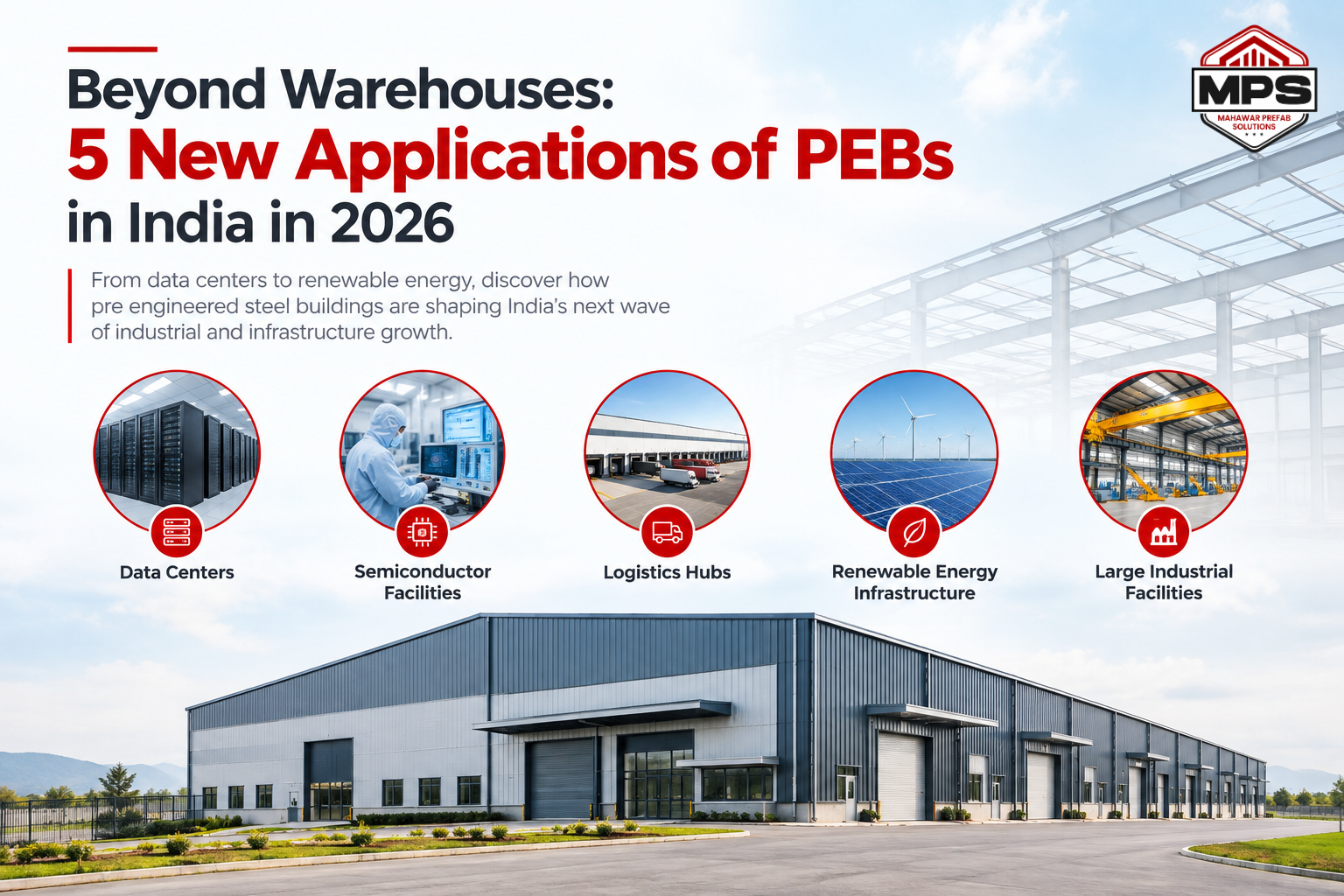
Here are five emerging applications of PEB technology in India.
1. Data Centers
India’s growing digital economy is driving demand for data centers across major business and technology markets. These facilities require large, carefully planned spaces for servers, electrical systems, cooling equipment, backup power and other critical infrastructure.
While the technical requirements of a data center are highly specialized, PEB systems can have a role in the structural shell and supporting spaces.
Why PEBs can be useful for data center projects
Data centers often require large clear-span areas and well-organized service zones. Steel structures can provide the structural flexibility needed to accommodate equipment layouts and future modifications.
Some potential advantages include:
- Large column-free or low-column interior spaces
- Faster structural erection
- Flexible building layouts
- Easier integration of service areas
- Possibility of future expansion
- Efficient use of structural steel
PEB systems can also be considered for supporting buildings such as electrical rooms, utility buildings, maintenance facilities, generator enclosures and storage areas.
However, data centers have demanding requirements for fire protection, thermal performance, security, vibration control and environmental conditions. Therefore, the PEB structure must be engineered according to the project’s specific technical requirements rather than treated as a standard industrial shed.
2. Semiconductor and Electronics Manufacturing Facilities
India’s electronics and semiconductor ecosystem is expanding, creating demand for specialized manufacturing infrastructure.
Semiconductor facilities are very different from conventional factories. They may require controlled environments, specialized mechanical and electrical systems, cleanrooms and highly precise construction standards.
The role of steel construction can therefore extend beyond simply creating an outer shell.
Where PEB technology can contribute
Prefabricated steel buildings can potentially be used for selected structural and support components around specialized production environments.
Applications may include:
- Manufacturing support buildings
- Utility and service structures
- Warehousing areas
- Material handling spaces
- Equipment support areas
- Ancillary industrial buildings
The major advantage is the ability to manufacture many structural components in a controlled factory environment before transporting them to the project site.
This approach can help organize construction activities and reduce the amount of structural fabrication required directly at the site.
For highly specialized semiconductor projects, however, the building solution needs to be developed around the process requirements. PEB is not a replacement for cleanroom technology or specialized building systems; instead, it can form part of a larger engineered construction solution.
3. Logistics Hubs and Distribution Centers
The growth of e-commerce, organized retail, third-party logistics and supply-chain networks is changing India’s warehousing requirements.
Modern logistics facilities are no longer limited to simple storage warehouses. Large distribution centers may include sorting areas, loading docks, packaging zones, offices, cold-chain sections and automated material-handling systems.
This makes flexibility particularly important.
Why PEBs suit modern logistics infrastructure
A logistics hub generally needs:
- Large floor areas
- High clear heights
- Efficient vehicle movement
- Multiple loading and unloading points
- Flexible internal layouts
- Scope for expansion
- Fast project execution
PEBs can address many of these structural requirements through optimized steel framing and large-span construction.
Another important advantage is the ability to plan the building around the operational workflow.
For example, a distribution center can be designed with dedicated areas for receiving, storage, sorting, dispatch and vehicle circulation instead of adapting an existing building to the logistics process.
This makes pre engineered steel buildings a practical option for companies developing large-scale logistics infrastructure.
4. Renewable Energy Infrastructure
India’s renewable energy sector is undergoing rapid expansion, particularly in solar and other clean-energy infrastructure.
Large renewable energy projects require more than the primary energy-generation equipment. They also need warehouses, maintenance buildings, control rooms, equipment shelters, workshops and other supporting structures.
This creates another potential application for PEB technology.
PEB applications in renewable energy projects
Steel buildings can be considered for:
- Solar project warehouses
- Operations and maintenance buildings
- Equipment storage facilities
- Electrical and utility buildings
- Workshops
- Control and support structures
- Industrial sheds for renewable-energy equipment
One of the key benefits is construction flexibility.
Renewable energy projects are often developed across large sites where construction logistics can be challenging. Factory-fabricated steel components can help reduce the amount of fabrication work required at the project location.
PEB systems can also be designed for different site conditions and project requirements, making them suitable for supporting infrastructure across a variety of renewable-energy developments.
5. Large Industrial Facilities
Perhaps the biggest opportunity for PEBs remains large-scale industrial development—but the definition of an industrial facility is changing.
Modern industrial projects can include automotive manufacturing, engineering plants, heavy fabrication units, food-processing facilities, consumer-product manufacturing and specialized production centers.
These facilities often require large working areas, overhead cranes, production lines, storage zones and future expansion capabilities.
Why PEBs are suitable for large industrial projects
A well-engineered PEB structure can provide:
- Large clear spans
- High structural efficiency
- Flexible internal layouts
- Faster erection compared with many conventional construction approaches
- Easy integration of doors, ventilation and service systems
- Provision for future expansion
- Compatibility with industrial equipment requirements
For projects involving cranes or heavy machinery, the structural design becomes particularly important. The building needs to account for crane loads, equipment loads, wind forces, seismic conditions and other project-specific parameters.
This is why industrial PEB projects should be engineered according to the actual operational requirements of the facility.
Why PEB Applications Are Expanding in India
The growth of PEB applications is not simply about replacing concrete construction with steel.
It is about finding construction systems that can respond to the requirements of modern industrial projects.
Several factors are contributing to this shift.
Faster Project Execution
Industrial projects often need to become operational within a defined timeline. Since many PEB components are fabricated before arriving at the site, structural erection can be organized efficiently.
Better Material Planning
Computer-aided engineering and fabrication allow structural members to be designed according to project requirements. This can improve material utilization and reduce unnecessary structural weight.
Flexible Design
Industrial buildings frequently change as businesses expand. Steel structures can provide flexibility for extensions, modifications and changes in internal layouts when planned from the beginning.
Factory-Controlled Fabrication
Manufacturing structural components in a controlled environment can improve consistency in fabrication and reduce dependence on extensive site-based fabrication.
Scalability
From a relatively small industrial facility to a large manufacturing or logistics complex, PEB systems can be engineered for different building sizes and requirements.
PEB Is Evolving Beyond the Traditional Industrial Shed
The future of PEB construction in India is not limited to warehouses.
As the country invests in digital infrastructure, electronics manufacturing, logistics networks, renewable energy and advanced industrial production, the demand for efficient structural systems is likely to create new opportunities for steel construction.
At the same time, every project has different requirements. A logistics warehouse, for example, has very different structural and operational needs from a semiconductor facility or a large manufacturing plant.
Therefore, the right approach is not simply to choose a PEB because it is faster or economical. The building system should be selected and engineered according to the project’s span, loads, height, operational requirements, site conditions, expansion plans and applicable standards.
Conclusion
PEBs are entering a broader phase of application in India’s construction industry.
From data centers and semiconductor support infrastructure to logistics hubs, renewable energy projects and large industrial facilities, steel construction can provide the flexibility and structural efficiency required by many modern projects.
The growing use of prefabricated steel buildings also reflects a wider shift toward factory-based construction, organized project execution and scalable infrastructure.
As India’s industrial and infrastructure landscape continues to develop in 2026 and beyond, PEB technology is likely to become increasingly relevant—not just for building warehouses, but for creating the infrastructure behind India’s next generation of industries.
 Contact: +91 8556800185
 Email: info@mahawarprefab.com