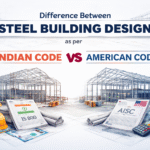
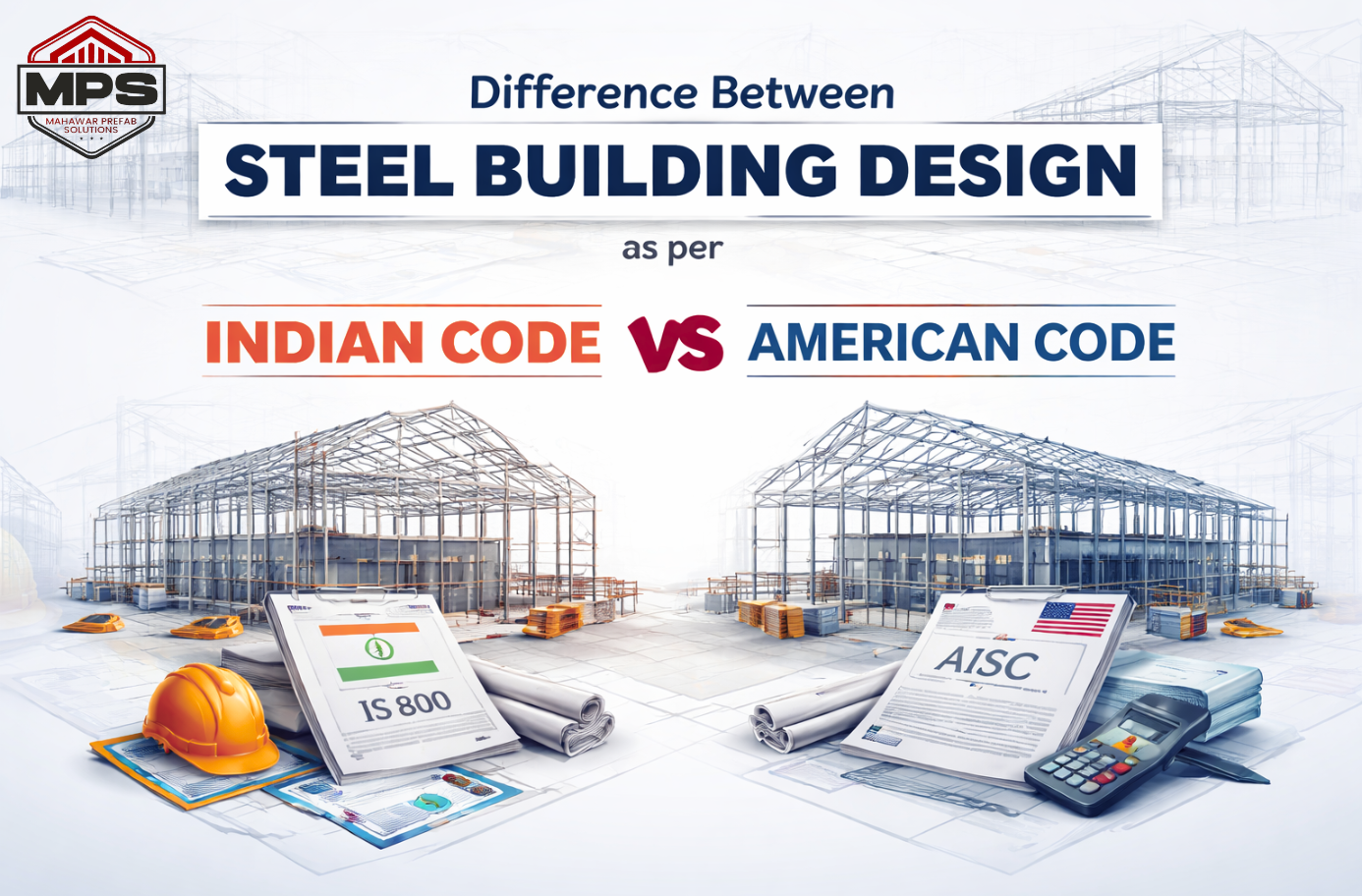
When planning a modern industrial shed, factory, or steel warehouse building, one of the most important technical decisions is the design code used for the structure.
In India, many projects are designed using Indian Standards (IS Codes), especially for government, institutional, and approval-sensitive works. On the other hand, many private industrial and pre-engineered building structures are often designed using American design practices such as AISC, ASCE, and MBMA for optimization and speed.
This creates a common question among clients, consultants, and project teams:
Which code is better for steel building design — Indian or American?
The answer is not about “better” in a generic sense. It depends on:
- project type
- approval authority
- client requirement
- design philosophy
- fabrication system
- cost optimization
- speed of execution
In this article, we will compare Indian Code vs American Code for steel building construction in a practical and technical way so that engineers, industrial clients, and project decision-makers can understand which approach suits their project best.
1) What Is Meant by Indian Code and American Code in Steel Building Design?
Indian Code
In India, structural steel buildings are commonly designed using:
- IS 800 – General construction in steel
- NBC India – National Building Code
- Other related Indian standards for loading, wind, seismic, welding, and connections
Indian building regulations and public sector projects usually rely heavily on this framework. IS 800 is the core Indian steel design code, and NBC 2016 serves as the national model code for building construction and structural design in India.
American Code
In the American system, steel buildings are typically designed using:
- AISC 360 – Structural steel design specification
- ASCE 7 – Design loads such as wind, seismic, dead, and live loads
- AISC 303 – Code of standard practice
- In many industrial/PEB applications, MBMA-based practices are also commonly used
AISC provides the steel design requirements, while ASCE 7 provides the load criteria used for general structural design.
2) The Biggest Difference: Design Philosophy
One of the main differences between the two systems is not just the code book itself — it is the design mindset.
Indian Code Approach
Indian code-based steel design is generally preferred where:
- compliance is critical
- approval authorities require Indian standards
- project documentation must align with local code expectations
- public sector / government work is involved
This is why many government buildings, public institutions, railway, defense, and state-level projects in India are commonly aligned with Indian code requirements.
American Code Approach
American code-based steel design is widely used in:
- industrial buildings
- logistics parks
- manufacturing plants
- export-oriented projects
- fast-track factory construction
- optimized steel warehouse building systems
- advanced pre-engineered building structures
This is because the American system is often seen as more fabrication-oriented, optimization-friendly, and detailing-driven for modern steel building systems.
Simple understanding
- Indian Code = more common for compliance-focused and approval-heavy projects
- American Code = more common for commercially optimized industrial steel buildings
That is why in India, you will often see this practical market trend:
Government and statutory-sensitive projects often prefer Indian code, while private industrial and PEB projects often adopt American design methodology.
3) Difference in Load Design Approach
A steel building is only as good as the loads considered in design.
This includes:
- Dead load
- Live load
- Wind load
- Seismic load
- Crane load (if applicable)
- Roof and service loads
Indian Code
Under Indian design practice, loads are considered as per the Indian code framework and project-specific requirements under the national standards system.
American Code
Under the American system, ASCE 7 is widely used to define minimum design loads and associated criteria for buildings and other structures, including wind, seismic, rain, snow, flood, and other hazards.
Practical difference
In many steel warehouse building and factory projects, the American load-based approach is often preferred because it is deeply integrated with modern steel optimization software and industrial building workflows.
This often helps in:
- better frame optimization
- more efficient member sizing
- smoother design-to-fabrication coordination
4) Difference in Member Optimization
This is where many clients see the real commercial impact.
Indian Code-Based Design
Indian code-based design is safe and reliable when done correctly, but in practical execution, some projects may become more conservative depending on:
- consultant design style
- software interpretation
- local approval expectations
- connection assumptions
- fabrication limitations
American Code-Based Design
American code-based systems are often more aligned with:
- optimized tapered sections
- built-up sections
- portal frame efficiency
- lightweight but safe industrial design
- advanced connection detailing
That is why many pre-engineered building structures and steel warehouse building projects are frequently developed using American-style design workflows.
Result
In many industrial cases, American code-based design can help achieve:
- lighter steel tonnage
- faster fabrication
- easier erection planning
- better system standardization
However, this only works well when the designer, fabricator, and execution team are experienced enough.
5) Difference in Connection Design and Detailing
A steel building is not only about columns and rafters.
The real engineering quality often shows in:
- bolted connections
- welded joints
- end plates
- base plates
- bracing joints
- crane beam supports
- splice connections
Indian Code
Indian code design can absolutely produce robust and safe connections, but in many local market projects, the detailing quality depends heavily on the consultant and fabrication team.
American Code
American design standards are often appreciated for their strong detailing culture, especially in industrial and commercial steel systems. AISC’s standards and practice documents are built around real-world fabrication, erection, tolerances, and contract coordination.
Why this matters
For a steel warehouse building, poor connection detailing can create problems such as:
- site mismatch
- erection delays
- bolt alignment issues
- rework cost
- structural performance concerns
So in real projects, the code matters — but detailing discipline matters even more.
6) Difference in Suitability for PEB and Industrial Buildings
This is one of the most important sections for your target audience.
Indian Code – Best Suited When
Indian code is often preferred when:
- the project is for government or semi-government bodies
- tender specifications require Indian standards
- approval authorities expect Indian references
- documentation needs local compliance alignment
- consultant or PMC mandates Indian code use
American Code – Best Suited When
American code-based methodology is often preferred when:
- the building is a steel warehouse building
- the project is a factory, logistics hub, or industrial shed
- speed and optimization are top priorities
- the structure is part of pre-engineered building structures
- the project requires efficient fabrication and erection
In short
If your project is a modern industrial PEB setup, American methodology is often more practical.
If your project is approval-driven, government-aligned, or compliance-heavy in India, Indian code is usually more appropriate.
7) Cost Difference: Which One Is More Economical?
This is the question every client asks first.
Can American code reduce cost?
In many practical industrial projects — yes, it can.
Why?
Because optimized steel design can reduce:
- steel consumption
- fabrication complexity
- erection time
- project turnaround time
This is one reason why many modern pre-engineered building structures are developed with design logic influenced by American steel building practice.
But does that mean Indian code is expensive?
Not necessarily.
A well-engineered Indian code-based structure can also be highly efficient if:
- the structural consultant is experienced
- the load assumptions are correct
- member design is optimized
- detailing is properly coordinated
Reality check
The biggest cost difference often comes not from the code name itself, but from:
- design optimization quality
- detailing quality
- fabrication accuracy
- erection planning
- project engineering discipline
So the right question is not:
“Indian code or American code — which is cheaper?”
The better question is:
“Which code system is more suitable for my project objective?”
8) Which Code Is Better for a Steel Warehouse Building?
For a typical steel warehouse building, the answer depends on the project category.
Choose Indian Code if:
- it is a government-linked project
- tender documents demand Indian standards
- local approval process requires Indian code references
- public authority compliance is a key part of the project
Choose American Code if:
- it is a private industrial or logistics project
- optimization and speed are important
- the structure is part of pre-engineered building structures
- your goal is efficient long-span steel design
Best practical industry view
For many modern warehouses, factories, and industrial buildings in India:
American code-based design workflow is often preferred for optimization, while Indian code-based design remains important for compliance and local approval context.
That is the most realistic and technically balanced answer.
9) Which Code Is Better for Pre-Engineered Building Structures?
When it comes to pre-engineered building structures, American code-based methodology has historically had stronger adoption in industrial steel systems because it aligns well with:
- tapered built-up members
- portal frame design
- long-span clear spaces
- rapid fabrication
- modular industrial construction
That is why many PEB manufacturers and industrial steel companies work comfortably with American-oriented design workflows.
However, in India, project requirements may still demand local code compatibility depending on:
- client specification
- consultant requirement
- approval conditions
- project location and authority
Best approach
For serious industrial clients, the ideal solution is often:
Design optimization with practical engineering logic + compliance alignment with project-specific code requirements
That is what creates a successful steel building — not just the code title.
10) Final Verdict: Indian Code vs American Code
So, what is the real difference between steel building design as per Indian code vs American code?
Indian Code is generally preferred for:
- government projects
- statutory compliance
- local code acceptance
- tender-based public works
- approval-driven buildings
American Code is generally preferred for:
- industrial buildings
- steel warehouse building projects
- optimized steel structures
- commercial PEB systems
- modern pre-engineered building structures
The smartest engineering answer is this:
Neither code should be selected blindly.
The best code is the one that matches:
- your project type
- client expectations
- approval requirement
- cost target
- structural efficiency goal
- fabrication capability
A successful steel building is not just about using Indian or American code.
It is about using the right engineering system for the right project.
Conclusion
If you are planning a steel warehouse building, factory shed, industrial unit, or pre-engineered building structures, understanding the difference between Indian code and American code can help you make a more informed technical and commercial decision.
In today’s construction market:
- Indian code remains highly relevant for government and compliance-sensitive projects
- American code remains highly effective for optimized industrial steel building systems
For the best results, your steel building should always be designed by a technically capable team that understands both structural safety and practical execution.
Because in steel construction, the right design approach can directly impact:
- project cost
- speed
- quality
- long-term performance