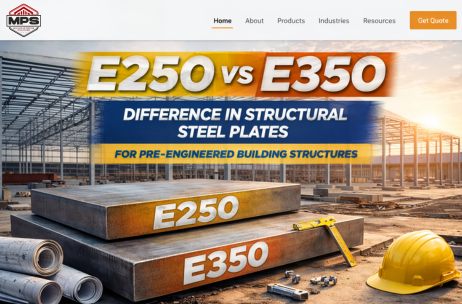
When planning a modern pre-engineered building structure, selecting the right steel grade is critical for safety, cost optimization, and long-term durability. Among IS 2062 structural steel grades, E250 and E350 are the most widely used for industrial sheds, warehouses, and heavy-duty prefabricated steel building projects.
But which one is better?
And how does the difference impact your PEB project cost?
This detailed technical guide explains the real engineering difference between E250 and E350 steel plates and how they affect structural performance in industrial construction.
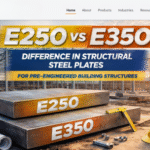
Quick Comparison: E250 vs E350
| Property | E250 | E350 |
| Minimum Yield Strength | 250 MPa | 350 MPa |
| Tensile Strength | 410–540 MPa | 490–630 MPa |
| Load Capacity | Moderate | High |
| Section Size | Larger | Smaller |
| Steel Tonnage | Higher | Lower |
| Ideal Use | Secondary Members | Primary Members |
Main Difference:
E350 has 40% higher yield strength than E250, making it more suitable for heavy-load pre-engineered building structures.
Understanding Steel Grades in PEB Construction
In a prefabricated steel building, structural members are subjected to:
- Axial load
- Bending moment
- Wind pressure
- Seismic force
- Crane load (if applicable)
The steel grade you choose directly affects:
- Frame strength
- Member thickness
- Building weight
- Foundation size
- Total project cost
That is why professional PEB designers carefully evaluate E250 vs E350 before finalizing structural drawings.
What is E250 Steel Plate?
E250 is a structural steel grade defined under IS 2062 with a minimum yield strength of 250 MPa.
Key Features:
- Good ductility
- Easy weldability
- Cost-effective
- Suitable for moderate load applications
Used In:
- Purlins
- Girts
- Bracing systems
- Small industrial sheds
E250 is commonly used in secondary framing members of pre-engineered building structures.
What is E350 Steel Plate?
E350 is a high tensile structural steel with minimum yield strength of 350 MPa.
Key Benefits:
- Higher load carrying capacity
- Reduced section thickness
- Lower structural weight
- Better performance in long-span buildings
Used In:
- Primary columns
- Rafters
- Main portal frames
- Heavy warehouse structures
For large-span prefabricated steel building projects, E350 is often preferred.
Engineering Perspective: Why Yield Strength Matters
Yield strength defines how much stress steel can withstand before permanent deformation.
If a warehouse span increases from 15m to 30m:
- E250 requires thicker sections
- E350 allows optimized section size
This results in:
✔ Reduced steel tonnage
✔ Lower transportation cost
✔ Smaller foundation
✔ Improved structural efficiency
That is why E350 is widely used in heavy-duty pre-engineered building structures.
Cost Analysis: Which One is More Economical?
Many assume E350 is expensive.
But real project cost depends on total tonnage.
Example Scenario:
If E250 design requires 100 tons
E350 optimized design may require 80–85 tons
Even if E350 price per ton is slightly higher, total structural cost can be lower.
For large prefabricated steel building projects, optimized steel design saves significant money.
When to Choose E250?
Choose E250 if:
- Span is below 20 meters
- Load intensity is moderate
- Budget is primary concern
- Used for secondary members
Ideal for light industrial sheds.
When to Choose E350?
Choose E350 if:
- Large warehouse
- Crane load present
- High wind zone
- Heavy machinery building
- Multi-span industrial structure
It is best suited for heavy-duty pre-engineered building structures.
Best Practice: Hybrid Steel Strategy
Most optimized PEB projects use:
- E350 → Primary Members
- E250 → Secondary Members
This combination provides strength + cost efficiency.
At Mahawar Prefab Solutions, we design structures based on load calculation, wind zone, seismic zone, and future expansion planning.
In the end
The difference between E250 and E350 steel plates significantly impacts:
- Structural safety
- Steel consumption
- Foundation cost
- Long-term durability
For high-performance prefabricated steel building projects, proper steel grade selection ensures maximum efficiency.
If you are planning a new industrial shed or warehouse, consult Mahawar Prefab Solutions for optimized structural design solutions.