Choosing a roofing sheet is not a small decision. For a factory, warehouse, or industrial shed, the roof is the single largest exposed surface of the building, and it takes the full brunt of sun, rain, wind, and, in many parts of India, industrial pollution. A wrong choice at the buying stage does not show up immediately — it shows up two or three years later as rust streaks, leaking joints, faded color, and a maintenance bill nobody budgeted for.
This guide is written for people who actually make this decision: factory owners, warehouse operators, industrial investors, architects, structural engineers, project consultants, and also procurement teams. It walks through what color coated roofing sheets are, how they are made, the technical specifications that matter, how to choose the right thickness and coating for your location, and the mistakes that most buyers make without realizing it.
Roofing selection affects three things directly — upfront cost, long-term durability, and ongoing maintenance. It also has a quieter fourth effect: energy cost. A roof with poor solar reflectivity can raise indoor temperatures inside a factory or warehouse by several degrees, which translates into higher cooling loads if the building is air-conditioned or ventilated mechanically. Getting the specification right at the design stage is far cheaper than fixing it after installation.
What Are Color Coated Roofing Sheets?
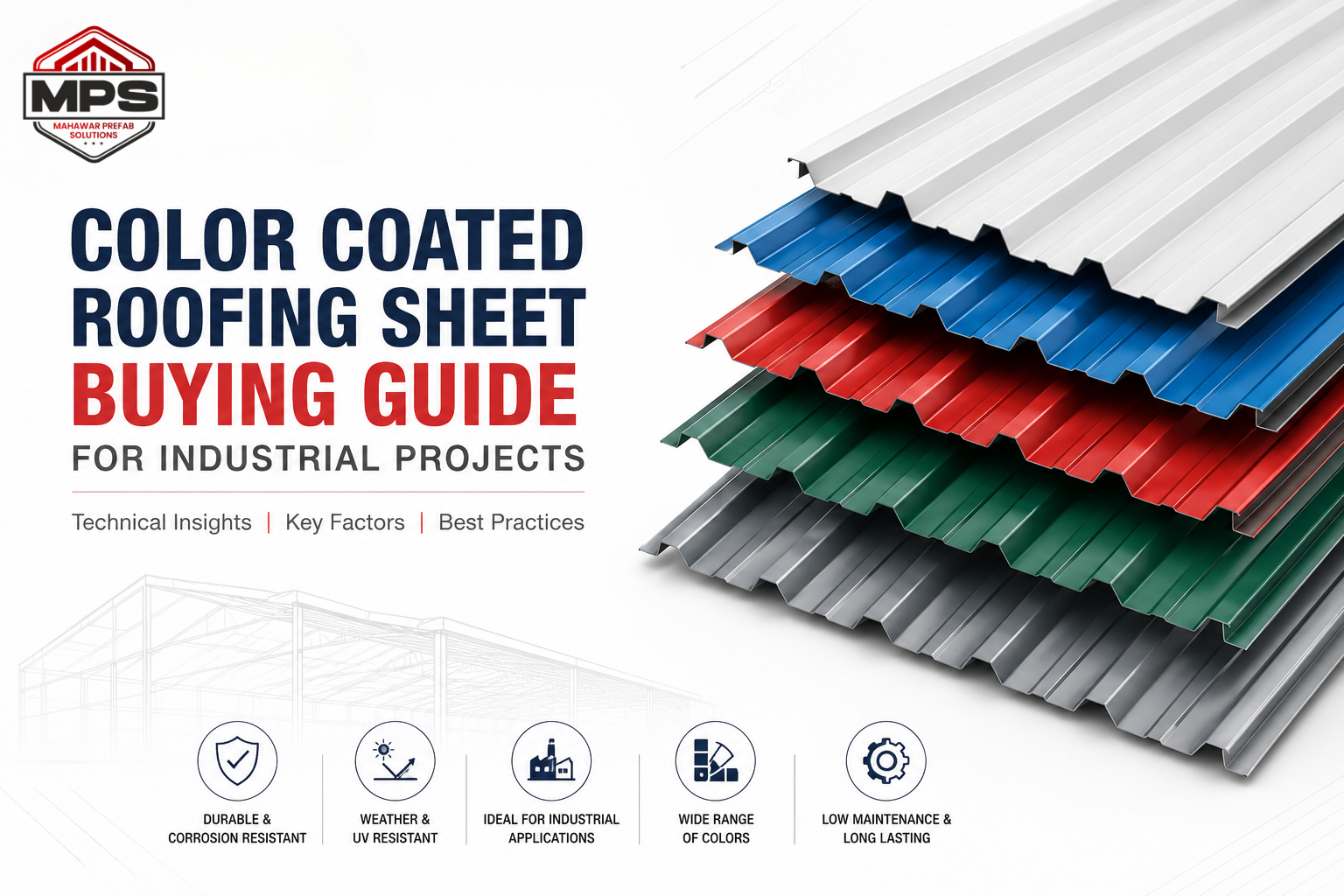
Color coated roofing sheets are metal roofing sheets manufactured from a base steel coil that goes through a multi-stage process: galvanizing or galvalume coating for corrosion resistance, followed by a color coating (paint) applied under controlled factory conditions, and finally roll-formed into the profile used on site.
The Manufacturing Process
- Base metal selection — A cold-rolled steel coil, typically manufactured to specific yield and tensile strength standards, is chosen as the substrate.
- Galvanization or galvalume coating — The steel coil passes through a hot-dip process where it is coated with either zinc (galvanized/GI) or a zinc-aluminium alloy (galvalume/AZ) to resist corrosion. This coating is measured in GSM (grams per square meter).
- Color coating (pre-painting) — The galvanized or galvalume coil is coated with paint — usually polyester, silicone-modified polyester (SMP), or PVDF (polyvinylidene fluoride) — in a continuous coil coating line. This is where PPGI (Pre-Painted Galvanized Iron) and PPGL (Pre-Painted Galvalume) get their names.
- Roll forming — The finished coil is fed through roll-forming machines that shape it into the trapezoidal, corrugated, or standing-seam profiles used for roofing.
Common Applications
Factory roofing, warehouse roofing, industrial shed roofing, cold storage buildings, poultry sheds, PEB (Pre-Engineered Building) roof and wall cladding, and also agricultural structures.
Key Advantages
- Better corrosion resistance due to the galvanized/galvalume base
- UV-resistant, factory-applied paint that resists fading longer than site-applied paint
- Lighter weight compared to concrete or clay roofing, reducing structural load
- Faster installation compared to traditional roofing systems
- Wide color range for aesthetic and branding purposes
- Better solar reflectivity when lighter shades or reflective coatings are used
Types of Color Coated Roofing Sheets
Not all color coated roofing sheets are built the same way. The base coating underneath the paint is what really determines long-term performance.
PPGI (Pre-Painted Galvanized Iron): Steel coated with zinc, then painted. Zinc coating protects steel through a sacrificial process — it corrodes before the steel does. Cost-effective and widely used, but generally has a shorter service life in highly corrosive or coastal environments compared to galvalume-based sheets.
PPGL (Pre-Painted Galvalume): Steel coated with a zinc-aluminium alloy (typically 55% aluminium, 43.4% zinc, 1.6% silicon), then painted. The aluminium content gives better barrier corrosion resistance and typically a longer service life, especially in humid or coastal regions.
Galvanized Sheets (GI, unpainted): Zinc-coated steel without color coating. Used where aesthetics are not a priority and cost is the main driver, such as some internal partitions or utility structures.
Galvalume Sheets (unpainted): Zinc-aluminium coated steel without paint. Offers good corrosion resistance and a natural metallic finish, often used for industrial sheds where painting is not required.
Aluminium Roofing Sheets: Pure aluminium sheets, naturally corrosion-resistant due to the oxide layer that forms on the surface. Lightweight and long-lasting, but generally more expensive and used in specialized applications like chemical plants or coastal structures with extreme corrosion exposure.
Technical Specifications
This is where most buying mistakes happen — because specifications are often glossed over verbally instead of being checked on paper. Here is what actually matters.
| Specification | Typical Range | Why It Matters |
| Thickness (TCT) | 0.30 mm – 0.60 mm | Determines strength, load capacity, and durability |
| GSM coating (zinc/AZ) | 90 – 275 GSM | Determines corrosion resistance |
| Yield strength | 240 – 550 MPa | Determines load-bearing capacity |
| Tensile strength | 340 – 570 MPa | Resistance to deformation under stress |
| Paint thickness | 15 – 25 microns (top coat) | Affects color retention and weather resistance |
| AZ coating (galvalume) | AZ100 – AZ150 | Aluminium-zinc alloy coating weight |
| GI coating | Z100 – Z275 | Zinc coating weight |
| Profile types | Trapezoidal, corrugated, standing seam | Affects load span and water drainage |
| Effective width | 1000 – 1080 mm (typical) | Actual covering width after overlap |
| Overall width | 1200 mm (typical coil-derived) | Width before overlap deduction |
| Length | Custom, up to 12m+ | Reduces transverse joints on long roofs |
| Weight | 3.5 – 6.5 kg/sq.m (approx.) | Affects structural design load |
| Fasteners | Self-drilling screws with EPDM washers | Prevents leakage at fixing points |
| Roof slope | Minimum 4–5 degrees (varies by profile) | Ensures proper water drainage |
| Wind load | Site-specific, per IS 875 | Determines fastener spacing and sheet gauge |
| Snow load | Site-specific | Relevant for hill and northern regions |
| Corrosion resistance | Coating and environment dependent | Determines maintenance-free lifespan |
| Thermal expansion | Standard for steel | Affects fastener hole design |
| Fire resistance | Class A (steel is non-combustible) | Important for factory insurance/compliance |
| Sound insulation | Improved with insulated panels | Relevant for high-rainfall regions |
| Reflectivity | Higher with lighter colors/reflective coatings | Reduces indoor heat gain |
| Solar performance | Cool-roof coatings improve SRI | Lowers cooling energy costs |
| Expected life | 15–30+ years (spec/environment dependent) | Long-term value assessment |
| Maintenance | Periodic cleaning and inspection | Preserves coating life |
Note on quoting figures: Actual figures vary by manufacturer, standard followed (IS, ASTM, or JIS), and also project specification. Always ask your supplier for a test certificate rather than relying on catalogue averages.
How to Choose the Right Color Coated Roofing Sheet
There is no single “best” roofing sheet — the right choice depends on site conditions and building use. Consider these factors together, not in isolation:
Location and climate: Coastal areas need higher corrosion resistance (PPGL over PPGI). Interior, drier regions can often work well with PPGI.
Rainfall: Higher rainfall areas need steeper slopes and better sealed overlaps.
Industrial pollution and chemical exposure: Sheds near chemical plants, fertilizer units, or heavy industrial zones need higher-grade coatings and sometimes specialized paint systems.
Wind speed: High wind-speed zones require thicker gauge sheets and closer fastener spacing, per IS 875 wind load calculations.
Snow load: Relevant for hill-station or northern industrial projects — affects purlin spacing and sheet thickness.
Temperature range: Extreme heat regions benefit from reflective/cool-roof coatings.
Building use: A cold storage facility has very different insulation needs compared to a dry warehouse.
Budget vs lifecycle cost: The cheapest sheet upfront is not always the cheapest option over 15–20 years once repainting and replacement are factored in.
Warranty terms: Check whether the warranty covers paint fade, chalking, and corrosion — and for how many years each.
Manufacturer credibility: Ask for test certificates, not just claims.
Installation quality: Even the best sheet fails early if installed with poor overlap or wrong fasteners.
Future maintenance access: Roofs that are hard to access for inspection tend to get neglected — factor this into slope and layout design.
Quick Buying Checklist
☐ Confirm base coating type (PPGI/PPGL) suited to your environment
☐ Confirm sheet thickness based on span and load
☐ Confirm GSM/AZ coating weight
☐ Ask for mill test certificate
☐ Check paint system (polyester/SMP/PVDF) and warranty years
☐ Verify profile compatibility with your purlin spacing
☐ Confirm fastener type and spacing plan
☐ Check roof slope against manufacturer’s minimum recommendation
☐ Ask about site-specific wind load calculation
☐ Clarify delivery lead time and transport handling plan
Common Mistakes Buyers Make
- Choosing thickness based on price alone, without checking span and wind load requirements.
- Assuming all PPGI sheets are the same — coating weight and paint quality vary widely between suppliers.
- Ignoring the coastal/industrial corrosion factor and picking PPGI where PPGL was needed also.
- Not asking for a mill test certificate, relying only on verbal assurances.
- Underestimating roof slope requirements, leading to water pooling and leaks.
- Using the wrong fasteners or skipping EPDM washers, causing early leakage at fixing points.
- Ignoring overlap specifications during installation, especially at end laps.
- Choosing dark colors in high-heat regions without considering solar reflectivity.
- Not checking warranty exclusions — many warranties exclude coastal or high-pollution zones unless specified upfront.
- Overlooking transportation and storage damage, which can scratch paint coating before installation even begins.
- Skipping a proper maintenance schedule, assuming color coated sheets are “maintenance-free” forever.
- Selecting a manufacturer purely on lowest quote, without evaluating quality control or after-sales support.
- Not accounting for thermal expansion in fastener hole sizing, leading to stress cracks over time.
Roofing Sheet Thickness Guide
| Thickness | Typical Recommended Use |
| 0.35 mm | Light-duty applications, short spans, budget-conscious sheds with low wind exposure |
| 0.40 mm | General industrial sheds, moderate spans |
| 0.45 mm | Standard factory and warehouse roofing, medium spans and wind zones |
| 0.47 mm | Slightly higher load and wind zones than 0.45 mm |
| 0.50 mm | Larger spans, higher wind load zones, heavier-duty industrial roofing |
| 0.60 mm | Heavy-duty industrial and PEB applications, high wind/snow load areas, longer design life |
General recommendation: For most standard factory and warehouse projects in moderate wind zones, 0.45 mm–0.50 mm is a common working range, but the final decision should always be backed by a structural calculation based on your specific span, purlin spacing, and local wind load data — not thickness alone.
PPGI vs PPGL: Detailed Comparison
| Parameter | PPGI | PPGL |
| Base coating | Zinc (Galvanized) | Zinc-Aluminium alloy (Galvalume) |
| Corrosion resistance | Good | Better, especially in humid/coastal areas |
| Typical coating weight | Z100–Z275 | AZ100–AZ150 |
| Cost | Generally lower | Generally higher |
| Best suited for | Dry, inland regions with lower corrosion risk | Coastal, humid, or high-pollution industrial zones |
| Cut-edge protection | Zinc offers sacrificial protection at cut edges | Slightly less sacrificial action, but stronger barrier protection overall |
| Typical service life | Moderate | Longer, in corrosive environments |
| Common applications | General factory/warehouse roofing | Coastal factories, chemical plants, cold storage, high-durability projects |
Neither option is universally “better” — PPGL commands a price premium for a reason, but that premium is only justified when the site conditions call for it. For a dry, inland warehouse, PPGI is often a perfectly sound and more economical choice.
Color Selection Guide
Color choice on a color coated roofing sheet is not purely aesthetic — it has functional consequences too.
Heat reflection: Lighter shades (white, light grey, sky blue) reflect more solar radiation and also reduce indoor heat gain compared to darker shades like dark brown or black.
Aesthetics and branding: Corporate color schemes are often matched to roofing and cladding colors for visual identity across factory campuses.
Industrial environment: Lighter colors show dust and grime faster in high-pollution zones; darker colors mask dirt better but absorb more heat.
Maintenance visibility: Some colors make early signs of chalking or fading more noticeable, which can actually help with proactive maintenance.
A practical approach: prioritize solar reflectivity for large-roof-area buildings in hot climates, and treat branding color-matching as a secondary factor unless the project specifically demands it.
Installation Best Practices
Fasteners: Use manufacturer-recommended self-drilling screws with EPDM rubber washers, driven straight (not at an angle) to avoid leak points.
Overlap: Follow the specified side-lap and end-lap dimensions — under-lapping is one of the most common causes of leaks.
Slope: Never install below the manufacturer’s minimum recommended slope for the chosen profile.
Handling: Sheets should be lifted, not dragged, to avoid scratching the paint surface, which can start early corrosion at the scratch point.
Storage: Store sheets on a slight incline, off the ground, and also covered, to prevent water pooling between stacked sheets before installation.
Transportation: Use edge protection and secure strapping to prevent movement and surface damage during transit.
Safety: Roof installation crews should follow standard fall-protection and safe working-at-height protocols throughout.
Waterproofing: Use appropriate sealants at ridge, valley, and flashing junctions in addition to overlap fastening.
Maintenance Guide
Color coated roofing sheets are low-maintenance, not maintenance-free. A simple annual routine extends service life significantly:
Inspection schedule: At least twice a year — typically pre-monsoon and post-monsoon — plus after any major storm.
Cleaning: Remove debris, leaves, and dust build-up, particularly around gutters and also valleys, to prevent water pooling.
Corrosion prevention: Check cut edges, fastener points, and any areas where paint has been scratched during installation or maintenance work.
Fastener inspection: Check for loosened or backed-out screws and worn EPDM washers, replacing as needed.
Leak prevention: Inspect overlaps and flashing points, especially at roof penetrations for pipes or ducts.
Repainting: Some sheets can be recoated after many years of service if the base steel is still sound — consult the manufacturer before attempting this.
Cost Factors
Several variables influence what a color coated roofing sheet installation costs, without getting into specific price figures:
- Sheet thickness and grade selected
- Coating type (PPGI vs PPGL) and coating weight (GSM/AZ)
- Paint system used (polyester, SMP, or PVDF) and warranty duration
- Profile complexity and custom length requirements (reducing joints can add cost but reduce leak risk)
- Total roof area and wastage factor during installation
- Site accessibility and transportation distance from the manufacturing unit
- Installation labor and crane/equipment requirements
- Accessories — ridge caps, flashing, gutters, insulation layers
- Structural modifications needed to support the chosen sheet weight and load requirements
- Delivery timelines and any expedited production requirements
Why Manufacturer Selection Matters
The sheet’s performance on your roof depends as much on who made it as on the specification sheet. Key factors to evaluate in a manufacturer:
Quality control: Consistent coil coating thickness, in-line testing, and adherence to specification tolerances.
Steel sourcing: Traceable, standard-compliant base steel rather than unverified sources.
Testing: Availability of mill test certificates for coating weight, tensile strength, and paint adhesion.
Warranty: Clear, written terms covering corrosion, paint fade, and chalking — not verbal promises.
Delivery reliability: On-time delivery matters for project timelines, especially for PEB projects with tight schedules.
Engineering support: Ability to advise on thickness, profile, and load requirements specific to your site, not just sell off a catalogue.
After-sales service: Responsiveness if an issue arises post-installation.
Customization: Ability to produce custom lengths, profiles, and colors to reduce joints and also wastage.
Why Choose Mahawar Prefab Solutions
Mahawar Prefab Solutions manufactures color coated roofing sheets, industrial roofing sheets, metal roofing sheets, PEB structures, and steel buildings, with a focus on getting the fundamentals right — consistent coating quality, accurate gauge thickness, and specifications that are tested rather than assumed.
What this looks like in practice:
- Modern manufacturing setup with roll-forming lines calibrated for consistent profile accuracy
- Quality testing on coating weight, thickness, and paint adhesion before dispatch
- Customization of profiles, lengths, and colors to match specific project and structural requirements
- Industry expertise built specifically around industrial roofing, PEB, and steel structure projects
- An experienced engineering team available to advise on thickness and specification choices based on site conditions, not just catalogue defaults
- Timely delivery planning that accounts for project timelines on factory and warehouse builds
- Experience across projects across India, adapting specifications to regional climate and site conditions
- A customer-centric approach to specification discussions rather than a one-size-fits-all catalogue sale
- Reliable technical support before, during, and after installation
If you are evaluating roofing sheet suppliers for an upcoming factory, warehouse, or industrial shed project, it’s worth having a specification conversation before finalizing your order — the right thickness and coating combination for your site is rarely the cheapest catalogue option, but it is usually the most cost-effective one over the life of the building.
Conclusion
A color coated roofing sheet is not a commodity purchase — it’s a long-term structural and financial decision. The right combination of base coating (PPGI vs PPGL), thickness, paint system, and profile depends entirely on your site’s climate, pollution exposure, wind and load conditions, and the intended use of the building. Buyers who skip the specification conversation and choose purely on price tend to pay for it later in maintenance, repainting, or premature replacement.
If you’re planning a factory, warehouse, or industrial shed project and want a roofing specification matched to your actual site conditions rather than a generic catalogue answer, the team at Mahawar Prefab Solutions is available to walk through the technical details with you before you finalize your order.