Is water dripping through your industrial shed roof every time it rains? You are not alone. Shed roof leakage is one of the most common and costly problems faced by factory and warehouse owners across India. The good news is that most leakages are completely preventable — if you understand why they happen and use the right materials from the start. In this guide, Mahawar Prefab Solutions walks you through every cause of industrial shed roof leakage and the most effective solutions available in India today.
Why Shed Roof Leakage Is a Serious Problem in India
India’s climate is harsh on industrial roofs. Whether it is the heavy monsoon rains in Punjab and Haryana, the scorching summer heat in Rajasthan, or the high-speed winds during thunderstorms — your shed roof is under constant stress throughout the year.
A leaking shed roof is not just an inconvenience. It leads to serious downstream consequences for your business:
- Damage to machinery, raw materials, and finished goods stored inside
- Structural weakening of the steel frame over time due to rust and water ingress
- Electrical hazards when water drips near wiring and electrical panels
- Increased repair and maintenance costs every year
- Loss of production time when workers cannot operate in a wet environment
The sooner you identify the root cause of your shed roof leakage, the sooner you can apply the right industrial shed roof repair solution and protect your investment.
Key Insight: According to field experience by Mahawar Prefab Solutions, over 70% of all industrial shed roof leakage cases in North India are caused by fastening failure — not by the roofing sheets themselves. Choosing the wrong screws is the single biggest mistake shed owners make.
Top 7 Causes of Shed Roof Leakage in India
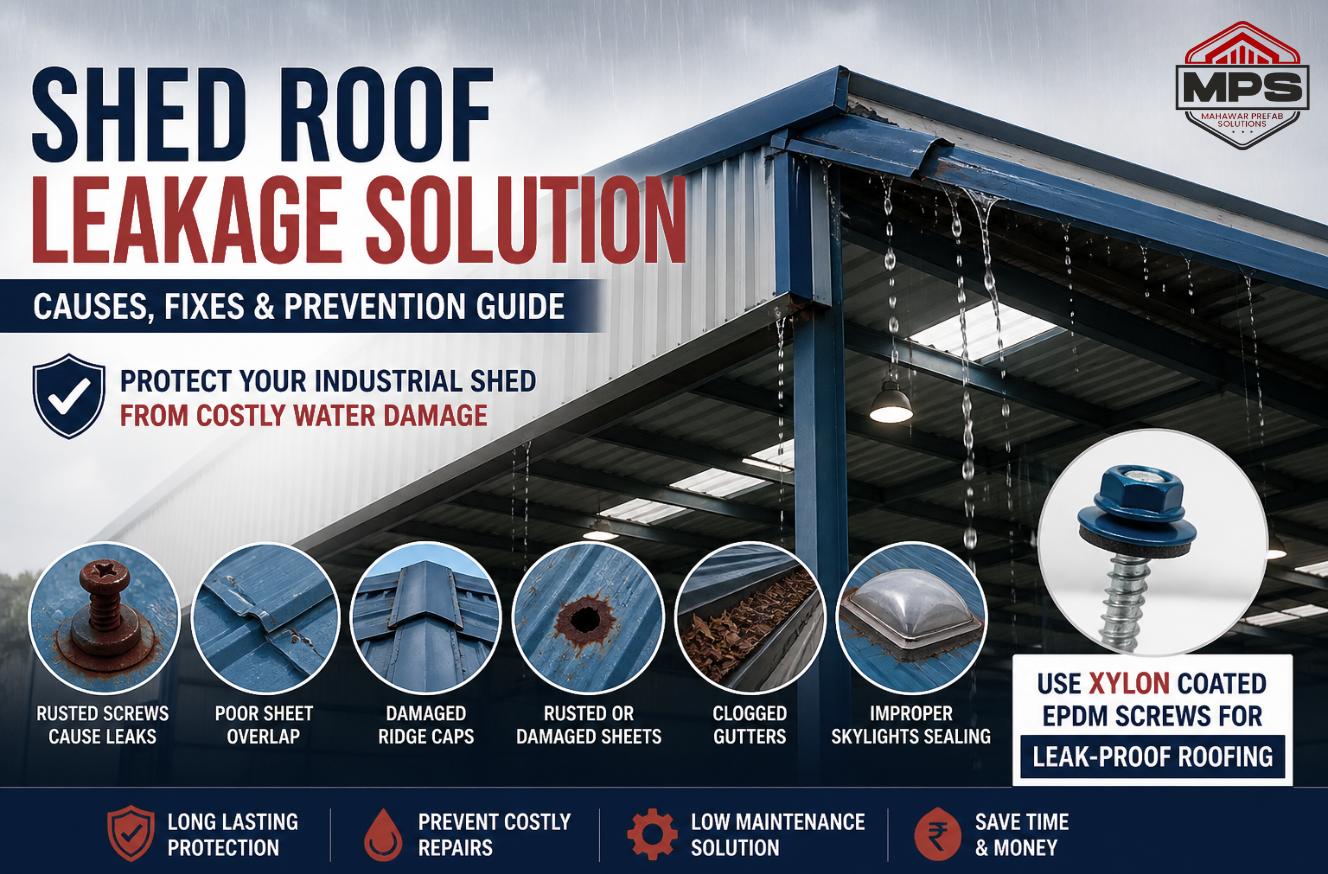
1. Wrong or Low-Quality Roofing Screws
This is the number one cause of shed roof leakage across industrial properties in India. Many shed contractors use basic galvanized screws to cut costs. These screws rust within 2–3 years, lose their grip, and allow water to seep in through the fastening holes.
The washer under a cheap screw also degrades quickly, leaving an open gap between the screw head and the GI sheet. Every heavy rain pushes water directly through these gaps into the shed.
- Avoid: Local or basic galvanized screws — rust-prone, weak grip, leakage risk
- Recommended: Xylon coated screws with EPDM washer — leak-proof, rust-resistant, long life
2. Poor Overlapping of Roofing Sheets
GI sheets and colour-coated sheets must overlap by a specific minimum length to prevent water from entering at the joints. When overlapping is too short — which often happens when contractors try to save material — rainwater driven by wind easily enters through the seams.
The standard overlap for industrial shed roofing in India should be at least one full corrugation width on the sides and a minimum of 150–200 mm on the end laps.
3. Damaged or Missing Ridge Caps
The ridge cap sits at the top peak of your shed roof and covers the joint where two roof slopes meet. This is one of the most vulnerable points on any industrial shed. When ridge caps are damaged, poorly fitted, or missing altogether, rainwater enters directly at the highest point and flows down inside the entire roof structure.
4. Rusted or Damaged GI Sheets
Over time, especially in areas with high humidity or coastal proximity, GI roofing sheets develop rust spots. Once the zinc coating is compromised, the base metal is exposed and corrodes rapidly. Rust holes — even tiny ones — allow water to drip through, especially during heavy monsoon rains.
Colour-coated sheets and pre-painted galvanized steel offer significantly better resistance to corrosion and are recommended for long-life roofing installations.
5. Clogged or Damaged Gutters and Drainpipes
Industrial sheds with perimeter gutters often face leakage not from the roof itself but from overflowing gutters. When gutters are blocked by leaves, dust, or bird nests, water overflows and runs back under the roofing sheets at the eave line. Regular gutter cleaning is a simple but often overlooked maintenance step.
6. Thermal Expansion Cracks
In regions like Rajasthan and Gujarat where summer temperatures exceed 45°C, metal roofing sheets expand and contract significantly between day and night. Over years, this repeated thermal movement can cause minor cracks at the sheet joints, screw holes, and flashings — all of which become entry points for rainwater.
7. Improper Installation of Skylights and Ventilators
Many industrial sheds have polycarbonate skylights or natural ventilators installed in the roof for light and airflow. If these are not sealed and flashed correctly at the edges, they become a direct path for water entry — often causing leaks that appear far from the actual source, making them difficult to diagnose.
Shed Roof Leakage Solution: How to Fix Each Problem
Fix 1: Replace Screws with Xylon Coated EPDM Screws
If your leakage is caused by failed fasteners — which is the case for most sheds older than 3–5 years — the best and most permanent shed roof leakage solution is to replace all existing screws with high-quality Xylon coated screws fitted with EPDM rubber washers.
👉 For best results, use trusted brands like:
- Hilti
- EJOT
- Corroshield
· EPDM Washer: Creates a watertight seal between screw head and sheet surface
· Xylon Coating: Protects the screw shank from rust and corrosion for 15+ years
· Bi-metal design: Prevents sheet cracking from over-tightening
Pro Tip from Mahawar Prefab Solutions: Always replace ALL screws during industrial shed roof repair — not just the visibly damaged ones. Partial replacement leaves weak points that will fail in the next monsoon season.
Fix 2: Re-overlap and Re-seal Sheet Joints
For leakage at sheet laps, the affected sheets must be lifted, cleaned, and re-laid with the correct overlap. Apply butyl tape or silicone sealant at the joints before re-fastening with new EPDM screws. This creates a fully sealed, double-protection joint.
Fix 3: Replace or Repair Ridge Caps
Damaged ridge caps should be removed completely and replaced with new ones. Use ridge caps that are designed to match your sheet profile — a mismatch leaves gaps. Apply foam closure strips and silicone sealant beneath the ridge cap before fastening to ensure a completely airtight and watertight seal at the peak.
Fix 4: Replace Rusted Sheets
Heavily rusted GI sheets cannot be reliably repaired with paint or sealant — the rust will continue spreading beneath any coating. The correct industrial shed roof repair approach is to identify and replace all sheets that show through-rust or structural thinning. Use colour-coated galvanized sheets (0.45–0.50 mm thickness) for replacements to extend the roof’s service life.
Fix 5: Clean and Repair Gutters
Clear all debris from gutters and check for cracks or misalignment. PVC or steel gutters with proper fall gradient (minimum 1:500) ensure water flows away quickly without accumulating. Add gutter guards in areas with heavy leaf fall to reduce future blockages.
Fix 6: Apply Waterproof Coating for Temporary Relief
For minor leakage from small cracks or pinholes, a waterproof elastomeric roof coating can provide 1–2 seasons of protection while you plan a complete roof renovation. Products like Dr. Fixit Roofseal or STP Elastocem Mono applied over clean, dry sheets seal hairline cracks effectively. Note: this is a temporary measure, not a permanent shed roof leakage solution.
How to Prevent Shed Roof Leakage — Best Practices
Prevention is always cheaper than repair. Mahawar Prefab Solutions recommends the following best practices for all new and existing industrial sheds in India:
- Always insist on Xylon coated screws with EPDM washers from day one of installation
- Use minimum 0.47 mm thickness GI or colour-coated sheets for long-term durability
- Ensure correct sheet overlaps — side lap minimum 1 corrugation, end lap minimum 175 mm
- Install foam closure strips under ridge caps and at eave lines
- Clean gutters before every monsoon season — at least once in April
- Get a professional roof inspection every 3–5 years to catch early signs of wear
- Avoid walking directly on GI sheets during maintenance — use crawl boards
Why Choose Mahawar Prefab Solutions for Industrial Shed Roof Repair
At Mahawar Prefab Solutions, we do not just supply roofing materials — we provide complete roofing systems designed to last. With years of experience in designing, supplying, and erecting prefab industrial sheds across Punjab, Haryana, Chandigarh, and Rajasthan, we understand every local challenge that leads to shed roof leakage.
- Complete roofing system supply: sheets, screws, ridge caps, gutters, sealants — all matched
- Only Xylon coated EPDM screws recommended and supplied — no compromise on fasteners
- Site visit and leak diagnosis available for existing shed owners
- Experienced erection team for full roof replacement and repair projects
- After-sales support and maintenance guidance for every installation
Contact Mahawar Prefab Solutions today for a free consultation on your shed roof leakage problem. Visit: www.mahawarprefab.com | Email: info@mahawarprefab.com