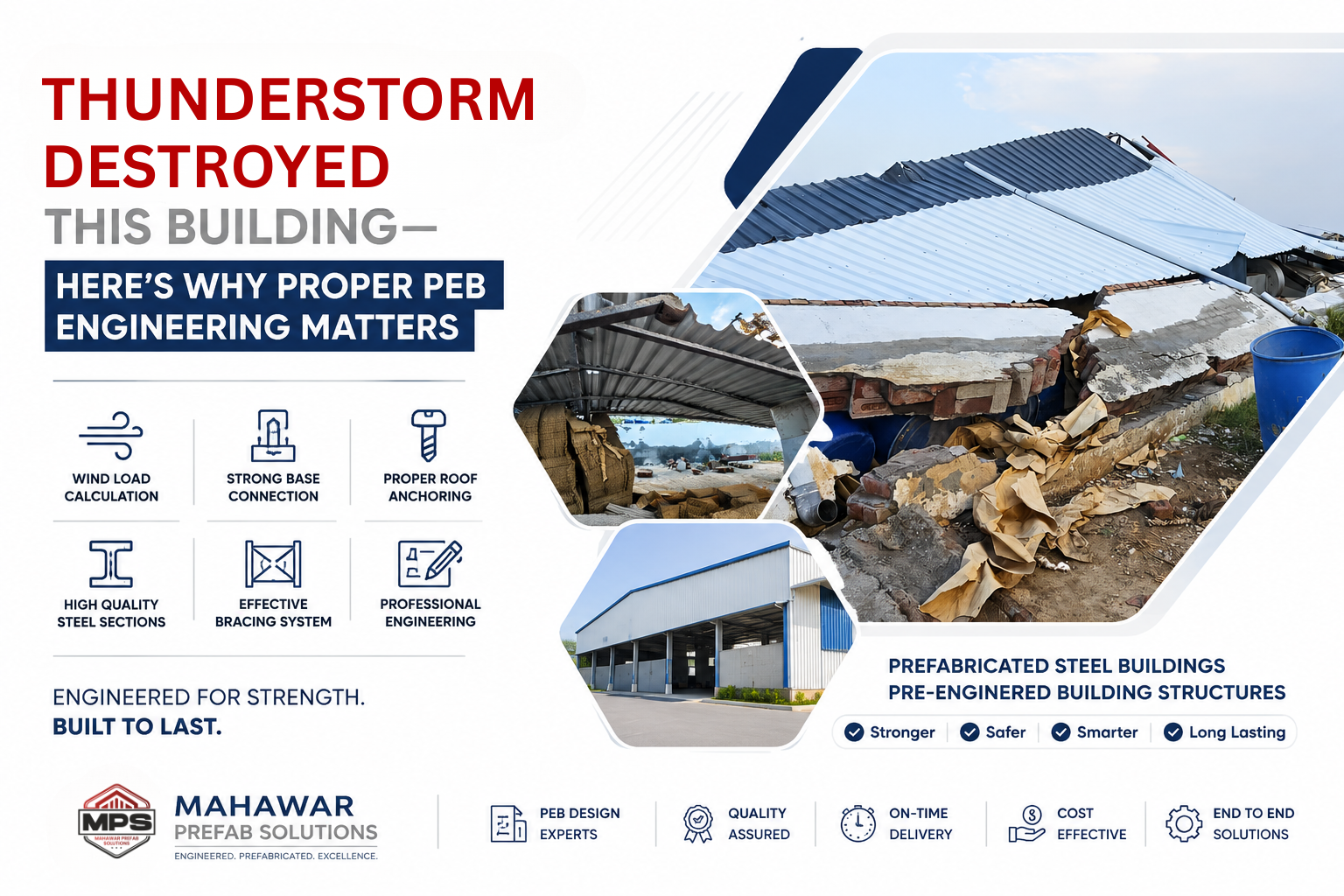
Industrial buildings are continuously exposed to environmental loads such as wind pressure, rain impact, thermal expansion, and seismic forces. During severe thunderstorms, these loads increase rapidly, and structures that are not professionally engineered often experience catastrophic failure.
The damage shown below is a clear example of structural instability caused by poor engineering practices, weak connections, and inadequate wind-resistant design.
For modern industries, warehouses, logistics parks, and manufacturing plants, professionally designed prefabricated steel buildings and engineered pre-engineered building structures are now essential for long-term structural safety.
Structural Failure Observed After Thunderstorm
Industrial Shed Collapse Due to Wind Uplift & Structural Instability
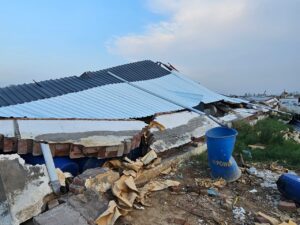
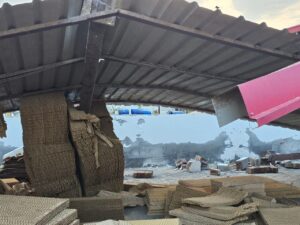
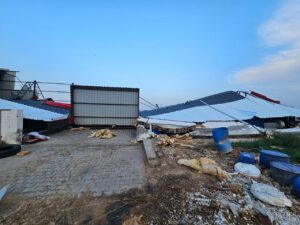
The above damage pattern indicates multiple engineering failures simultaneously:
- Excessive wind uplift on roofing sheets
- Failure of roof support members
- Weak column-to-base connections
- Lack of adequate bracing
- Non-engineered structural framing
Understanding Why Buildings Collapse During Thunderstorms
1. Incorrect Wind Load Calculation
Wind load is one of the most critical design parameters in industrial steel buildings.
When wind moves over a roof surface, it creates:
- Positive pressure on windward faces
- Negative suction pressure on roof surfaces
- Uplift forces at roof edges and corners
If the structure is not designed according to applicable wind codes, these forces exceed the structural capacity of the building.
In many locally fabricated sheds:
- Wind pressure coefficients are ignored
- Roof uplift calculations are absent
- Internal pressure effects are not considered
- Connection designs are under-engineered
This results in progressive structural failure during thunderstorms.
Professionally engineered pre-engineered building structures are designed using detailed wind analysis software and code-based calculations to ensure stability under extreme weather conditions.
For industrial applications, proper wind-resistant prefabricated steel buildings must consider:
- Basic wind speed zone
- Terrain category
- Building height
- Roof slope
- Internal pressure coefficients
- Local topography effects
2. Failure of Column-to-Foundation Connections
The column base connection transfers the entire building load into the foundation system.
During high wind uplift, significant overturning moments develop at the base of steel columns. Weak base connections cannot resist these forces.
Common failures observed in non-engineered sheds:
- Undersized anchor bolts
- Insufficient embedment depth
- Improper grout level
- Weak weld connections
- Thin base plates
Once anchor bolts fail, the structural frame loses stability rapidly.
In professionally designed pre-engineered building structures, base connections are engineered for:
- Shear force resistance
- Axial load transfer
- Moment resistance
- Wind uplift capacity
High-strength anchor systems significantly improve the performance of prefabricated steel buildings during cyclonic and thunderstorm conditions.
3. Roof Uplift Failure Due to Improper Roofing Anchorage
Roofing systems are usually the first components to fail during extreme wind events.
During thunderstorms, aerodynamic suction creates high uplift pressure at:
- Roof corners
- Eave regions
- Ridge areas
Improperly fastened roofing sheets detach under negative pressure.
Technical causes include:
- Incorrect fastener spacing
- Low pull-out resistance screws
- Thin purlin sections
- Poor overlap detailing
- Inadequate edge fastening
Once roofing sheets detach, internal pressure inside the building increases dramatically, causing progressive structural collapse.
Modern prefabricated steel buildings use:
- High tensile self-drilling fasteners
- Engineered sheet profiles
- Proper lap detailing
- Uplift-resistant roofing systems
This improves overall storm resistance of pre-engineered building structures.
4. Use of Low-Grade Structural Steel Sections
Structural steel quality directly affects load-bearing performance.
In low-cost conventional sheds:
- Secondary members are under-sized
- Steel thickness is reduced
- Material certification is absent
- Corrosion protection is poor
Under dynamic wind loading, weak sections experience:
- Excessive deflection
- Buckling
- Torsional instability
- Connection failure
Professionally manufactured prefabricated steel buildings use certified structural steel grades with controlled yield strength and tensile properties.
This ensures:
- Higher structural integrity
- Better fatigue resistance
- Improved durability
- Long-term dimensional stability
5. Inadequate Bracing System
Bracing systems stabilize steel structures against lateral loads.
Without proper bracing:
- Frames sway excessively
- Roof members deform
- Columns twist under load
- Structural resonance increases
In many damaged sheds, longitudinal stability systems are either absent or improperly designed.
A professionally engineered pre-engineered building structure includes:
- Roof bracing
- Wall bracing
- Tie rods
- Sag rods
- Portal action stability systems
These elements distribute wind forces uniformly throughout the structure.
Proper bracing significantly increases the lateral stability of prefabricated steel buildings.
6. Lack of Professional Structural Engineering
The primary difference between a conventional shed and a professionally engineered PEB lies in structural analysis.
Non-engineered structures are often fabricated based only on experience without:
- Structural modeling
- Load combinations
- Connection analysis
- Stability checks
- Deflection analysis
This creates unsafe structures vulnerable to collapse.
Professionally designed pre-engineered building structures undergo:
- Computerized structural analysis
- Wind load simulation
- Member optimization
- Seismic analysis
- Connection design verification
This ensures predictable structural performance under real loading conditions.
Why Prefabricated Steel Buildings Perform Better During Extreme Weather
Modern prefabricated steel buildings are specifically engineered for:
- High wind resistance
- Lower dead load
- Better load distribution
- Faster erection
- Greater structural efficiency
Compared to conventional fabrication systems, engineered pre-engineered building structures offer:
- Optimized steel consumption
- Reduced structural stress
- Superior connection detailing
- Higher durability
- Better safety margins
These advantages make them ideal for:
- Warehouses
- Manufacturing plants
- Logistics hubs
- Industrial sheds
- Export-oriented industries
Engineering Features That Prevent Structural Collapse
A certified PEB system includes:
- Wind code-compliant design
- Optimized primary steel framing
- High-strength bolted connections
- Proper anchorage systems
- Uplift-resistant roofing
- Galvanized secondary members
- Engineered bracing systems
This integrated engineering approach increases the reliability of prefabricated steel buildings under severe environmental loading.
Final Thoughts
Thunderstorms do not destroy properly engineered structures — poor engineering does.
The collapse shown above highlights the importance of:
- Accurate wind load design
- Strong connection detailing
- Quality structural steel
- Proper bracing systems
- Professional engineering analysis
For industries investing in long-term infrastructure, professionally designed pre-engineered building structures and certified prefabricated steel buildings provide significantly better safety, durability, and structural performance.
Companies like Mahawar Prefab Solutions focus on delivering engineered industrial structures designed for strength, durability, and long-term operational safety under demanding environmental conditions.