
Pre-Engineered Buildings (PEBs) have become the preferred infrastructure choice for industries worldwide due to their speed of construction, durability, and ability to provide long clear spans. Today, most businesses trust pre engineered steel buildings because they deliver superior strength and long-term reliability. However, a PEB is only as strong as the materials used to build it.
One of the most critical—yet often overlooked—elements of a reliable structure is the grade of steel.
While the industry standard demands safety and longevity, many fabricators compromise on quality to cut costs. This is especially dangerous in prefabricated steel buildings, where every structural component depends on certified and high-strength materials. In this post, we explain why High Tensile Steel (Grade E350) is essential for your building’s safety and why “saving” money on lower-grade steel is a risk you cannot afford to take.
Why High Tensile Steel (E350) is Essential
The core advantage of High Tensile Steel is its Yield Strength.
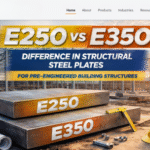
- Standard Steel (E250): Typically offers a yield strength of 250–330 MPa.
- High Tensile Steel (E350): Offers a minimum yield strength of 350 MPa.
The Impact on Performance
In PEB construction, structures must withstand massive forces, including heavy crane loads, wind pressure, and seismic activity. In modern steel construction, high tensile E350 steel can absorb significantly higher loads before yielding (bending or deforming) compared to lower grades.
When designers calculate the structural stability of a building, they often assume the use of 350 MPa steel. Using this grade allows for:
- Lighter Structures: Better strength-to-weight ratio reduces overall steel consumption.
- Superior Load Handling: Enhanced capacity to handle crane loads and wind forces without deformation.
- Safety: A higher safety margin against structural failure.
The Industry “Secret”: Why Local Fabricators Avoid E350
If E350 is superior, why doesn’t everyone use it?
The answer is simple: Cost.
Many local fabricators intentionally substitute E350 with lower-grade E250 material. By doing this, they can reduce their material costs by 8–10%. This practice becomes especially risky in pre engineered steel buildings, where material strength directly impacts long-term safety. Since most customers cannot visually distinguish between steel grades without testing, these fabricators pocket the difference while delivering a structurally weaker building.
The Dangerous Trap of “Local Flats” in H-Beams
The compromise often goes deeper than just swapping grades. A dangerous practice in the unorganized sector is the use of Local Flats (Patti) in H-Beam flanges.
In an H-Beam, the flanges take the maximum bending load. Therefore, the steel used here must be of the highest integrity. However, many workshops use “local flats”—re-rolled products made from scrap steel.
The Risks of Local Flats:
- Low Tensile Strength: Often below 270 MPa (20–25% weaker than standard plates).
- Inconsistent Thickness: Poor manufacturing tolerances lead to structural imbalances.
- No Certification: These materials come without a Mill Test Certificate (MTC).
- High Failure Rate: Increased risk of bending, deformation, or collapse under wind or seismic stress.

Using scrap-based flats makes a building structurally unpredictable. A PEB is a long-term investment; risking the entire asset to save a small percentage on steel is a dangerous gamble.
The Mahawar Prefab Solutions Standard: Uncompromising Quality
At Mahawar Prefab Solutions, we believe that structural integrity is non-negotiable. We strictly adhere to high-standard manufacturing practices to ensure your building lasts for decades.

Our Quality Pro
- 100% Prime E350 Plates: We never use local flats or E250 material for critical structural members.
- Verified Sourcing: We procure steel exclusively from branded, trusted mills, including TATA Steel, JSW Steel, and SAIL.
- In-House Testing: We do not rely blindly on certificates. Every batch of steel is tested on our Universal Testing Machine (UTM) before it enters the production line.
- Full Traceability: We maintain complete documentation and certification for every component used in your structure.