Updated: 7 October 2026
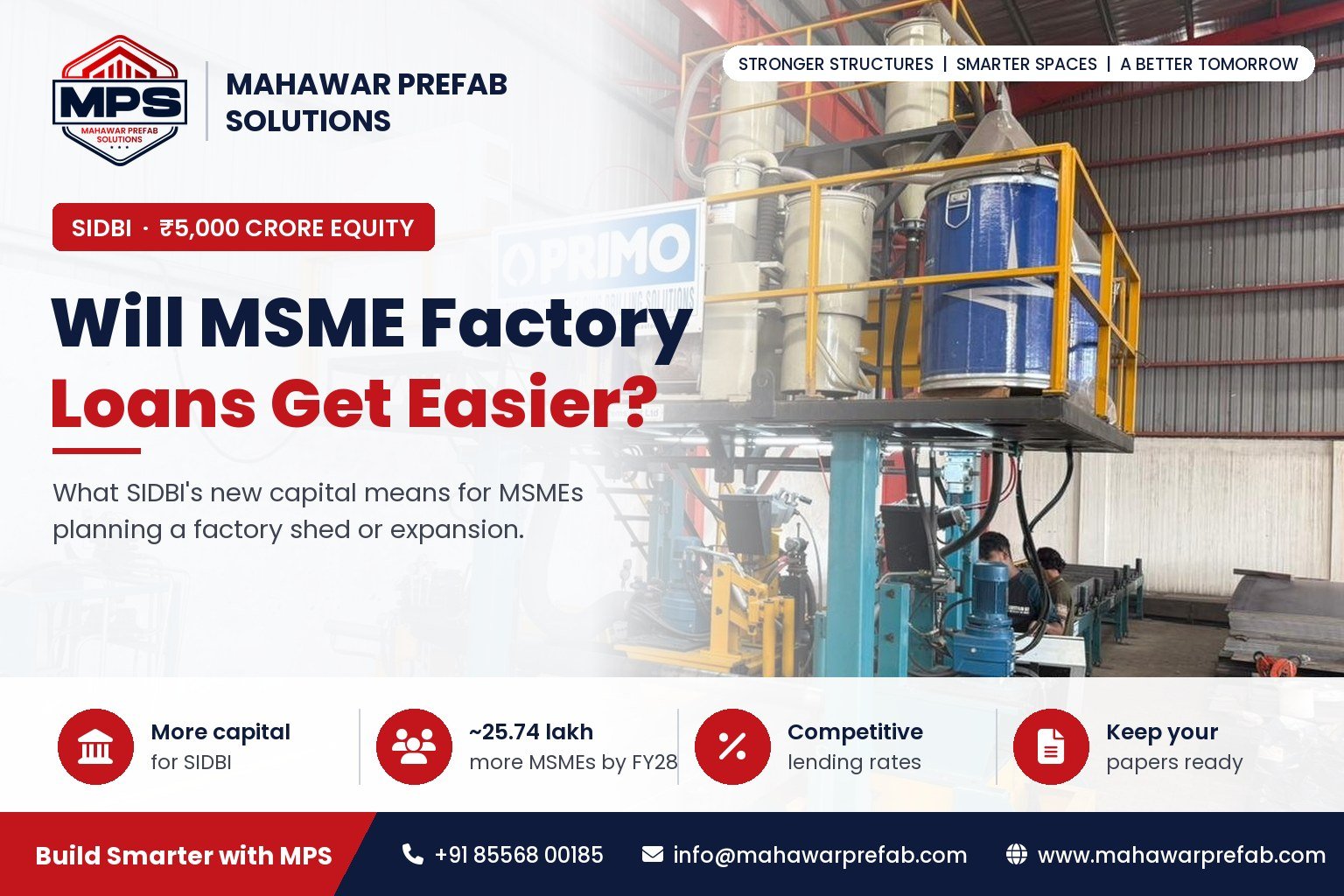
On 21 January 2026, the Union Cabinet approved Rs 5,000 crore of fresh equity for SIDBI (Small Industries Development Bank of India). This is capital for SIDBI itself, not a new loan scheme or subsidy you can apply to. What it does is give SIDBI room to lend more to MSMEs over the next few years, which can help when you approach SIDBI or your bank for a factory expansion loan.
Below we explain the decision in plain words, what it does and does not change, and how to prepare if a new factory shed or warehouse is part of your plan.
What the Cabinet approved
According to the PIB press release of 21 January 2026, the Department of Financial Services (DFS, part of the Finance Ministry) will put Rs 5,000 crore of equity into SIDBI in three parts:
| Tranche | Amount | Financial year | Price per share |
|---|---|---|---|
| 1 | Rs 3,000 crore | FY 2025-26 | Book value of Rs 568.65 (as on 31 March 2025) |
| 2 | Rs 1,000 crore | FY 2026-27 | Book value as on 31 March of the previous year |
| 3 | Rs 1,000 crore | FY 2027-28 | Book value as on 31 March of the previous year |
“Book value” here simply means the value of each SIDBI share as per its balance sheet. The government is buying new shares at that price.
Why does a bank need equity at all?
Every bank or lending institution must keep a cushion of its own money against the loans it gives. This cushion is measured by a ratio called CRAR (Capital to Risk-weighted Assets Ratio). In simple terms: the more loans a lender gives, and the riskier those loans are, the more of its own capital it must hold.
The PIB release says SIDBI expects its lending to MSMEs to grow over the next five years. It is also building digital, collateral-free loan products and gives venture debt (loans to start-ups) – all of which need more capital behind them. Without extra capital, SIDBI’s CRAR would fall. The equity keeps it healthy. PIB says the phased infusion will let SIDBI keep CRAR above 10.50% even under a high-stress scenario, and above 14.50% under Pillar 1 and Pillar 2 (the regulatory capital tests) over the next three years.
A healthy CRAR protects SIDBI’s credit rating. A good rating lets SIDBI raise money at fair interest rates, which PIB says will increase the flow of credit to MSMEs at a competitive cost. That is the chain the government is relying on.
How many MSMEs is it expected to reach?
PIB gives these expected figures:
- MSMEs receiving financial assistance: from 76.26 lakh at the end of FY 2025 to 102 lakh by the end of FY 2028.
- That is roughly 25.74 lakh new MSME beneficiaries.
- Using the average of 4.37 jobs per MSME (Ministry of MSME data as on 30 September 2025), PIB estimates about 1.12 crore jobs linked to these new beneficiaries.
These are government projections, not guarantees. Whether your unit benefits still depends on your own project, cash flows and the lender’s appraisal.
What the SIDBI equity infusion does NOT do
- It is not a subsidy. No part of the Rs 5,000 crore is paid to MSMEs as a grant.
- You cannot apply to it. There is no form, portal or deadline for borrowers. The money goes to SIDBI’s share capital.
- It does not change loan rules by itself. Eligibility, margin, collateral and interest rates are still set by SIDBI’s and each bank’s own policies.
- It is not the SME Growth Fund. The Rs 10,000 crore SME Growth Fund approved on 6 October 2026 is a separate scheme: the government will commit money to an AIF (a privately pooled investment fund registered with SEBI) that will invest equity in growing SMEs. The fund manager and application route are not yet announced. Read our explainer on the SME Growth Fund for MSME manufacturers.
How an MSME can actually use more SIDBI or bank credit
The practical takeaway: lenders, SIDBI included, should have more capacity to finance good MSME projects. To use that, you still need a bankable proposal.
SIDBI’s own term loans
SIDBI lends directly to MSMEs as well as through banks and NBFCs. Two products from SIDBI’s published product sheets are relevant for expansion:
| Product | Key points (as per SIDBI product sheet) |
|---|---|
| General Purpose Term Loan | For a new MSME unit, expansion or additional machinery; minimum loan Rs 10 lakh; debt-equity not above 3:1; promoter contribution generally 33% for new projects (up to 25% for well-performing existing units); tenure generally 8-10 years including up to 18 months moratorium; upfront fee generally 1%. |
| Secured Business Loan | For existing MSMEs with net profit in 2 of the last 3 years and cash profit in all 3; for any bona fide business expenditure; up to Rs 10 crore; up to 10 years; against collateral. |
The product sheets are not dated, so confirm current terms with your nearest SIDBI branch. Also note: no SIDBI or bank document we have seen says in so many words that it funds factory sheds. An expansion project may include a new building, but the lender decides what it finances after looking at your full project.
Other routes that work alongside
- CGTMSE (Credit Guarantee Fund Trust for Micro and Small Enterprises): guarantees collateral-free loans to micro and small units, now up to Rs 10 crore (from 1 April 2025). See our guide on CGTMSE loans and factory sheds.
- MCGS-MSME (Mutual Credit Guarantee Scheme for MSMEs): a 60% guarantee to the lender for loans up to Rs 100 crore for buying machinery or equipment, where at least 60% of the project cost must be machinery or equipment (PIB, 21 March 2026).
- State incentives: for example, Punjab’s Industrial & Business Development Policy 2026 (gazette dated 8 March 2026). See state subsidies for factory sheds in 2026.
For the full picture of this year’s schemes, start with our Budget 2026 MSME schemes guide.
What this means if you are planning a factory shed or warehouse
If you plan to expand in the next year or two, more lending capacity is useful only if your project file is ready. For a building, that means the lender can see a clear cost, a clear timeline and proper drawings.
1. Get a realistic cost estimate
Building cost depends on area, clear span, eave height, crane load, mezzanine, roofing and wall cladding. Our warehouse PEB cost guide explains the main cost drivers. If you are still choosing a structure type, compare PEB vs RCC on cost and time.
2. Keep the documents the bank usually asks for
Bank checklists for MSME term loans commonly ask for:
- Udyam certificate and GST registration
- Approved building plan and building permit (as applicable in your state)
- Estimate for civil construction and quotations for machinery and the building
- Project report with projections for the full loan period, including DSCR (debt service coverage ratio – whether your cash flow can cover the EMIs)
- Property papers for any security offered
For a pre-engineered building (PEB), a detailed quotation with the general arrangement (GA) drawings, steel and sheeting specifications, and a payment schedule helps the bank’s engineer appraise the cost. Ask your supplier to state the steel standard (IS 2062 (Part 1):2025 for structural steel) and that the design follows current Indian codes (for earthquake loads, IS 1893 (Part 1):2016 applies). GST on PEB supply is generally 18% – confirm with your CA.
3. Plan stage-wise construction
Banks often release term loans in stages against progress. A PEB fits this well because work happens in clear steps:
- Design and drawings approved
- Civil foundations and anchor bolts at site
- Steel fabrication at the plant and dispatch
- Erection of frames, purlins and sheeting
- Finishing, handover and stability certificate (in Punjab, a Form 1-F stability certificate is required before manufacturing starts in a new building)
Agree on a timeline with your supplier based on your actual size and site, and build some buffer into your loan disbursement plan.
4. Leave room to expand later
If you expect more growth, ask for the end wall to be designed for future extension. This is easier to plan at the design stage than to fix later. Also note: land and building are excluded from the Udyam investment figure, so a new shed does not by itself push you into a bigger MSME category.
You can see how a real project came together in our 20,000 sq ft warehouse case study at Tapa Mandi, and read more on our MSME loans for factory shed construction guide.
Need a quotation for your bank file?
Mahawar Prefab Solutions is itself an MSME with ZED Bronze certification, so we know how a loan file comes together. From our plant at Mandi Gobindgarh, Punjab, we design, fabricate and erect pre-engineered buildings across Punjab and other states we serve. Share your size and use, and we can prepare a detailed quotation and drawings for your bank.
Call toll-free 1800 309 1940, WhatsApp +91 85568 00185, or email info@mahawarprefab.com.
Frequently asked questions
What is the SIDBI Rs 5,000 crore equity infusion?
It is Rs 5,000 crore of share capital that the Central Government, through the Department of Financial Services, is putting into SIDBI in three tranches: Rs 3,000 crore in FY 2025-26 and Rs 1,000 crore each in FY 2026-27 and FY 2027-28. The Union Cabinet approved it on 21 January 2026.
Can I apply for money from the SIDBI Rs 5,000 crore fund?
No. It is capital for SIDBI, not a scheme for borrowers. It helps SIDBI lend more, but you still apply for a normal loan from SIDBI or your bank.
Will SIDBI loans become cheaper because of this?
The government says the extra capital will help SIDBI raise funds at fair rates and increase credit to MSMEs at competitive cost. Your actual rate will still depend on the lender’s policy and your credit profile.
Does SIDBI give loans for a factory building?
SIDBI’s General Purpose Term Loan covers setting up a new MSME unit and expansion, with a minimum loan of Rs 10 lakh. No official document we have seen names factory sheds specifically, so the lender decides what it finances after appraising your full project.
How many MSMEs will benefit from the SIDBI equity infusion?
PIB expects the number of MSMEs receiving financial assistance to rise from 76.26 lakh at the end of FY 2025 to 102 lakh by the end of FY 2028, about 25.74 lakh new beneficiaries.
What documents should I prepare for a factory shed loan?
Typically your Udyam certificate, GST registration, approved building plan and permit, cost estimate and quotations for the building and machinery, and a project report with DSCR projections. Ask your bank for its exact checklist.
Scheme details change; confirm with your bank, DIC or CA before applying. This is general information, not financial advice.