Updated: 7 October 2026
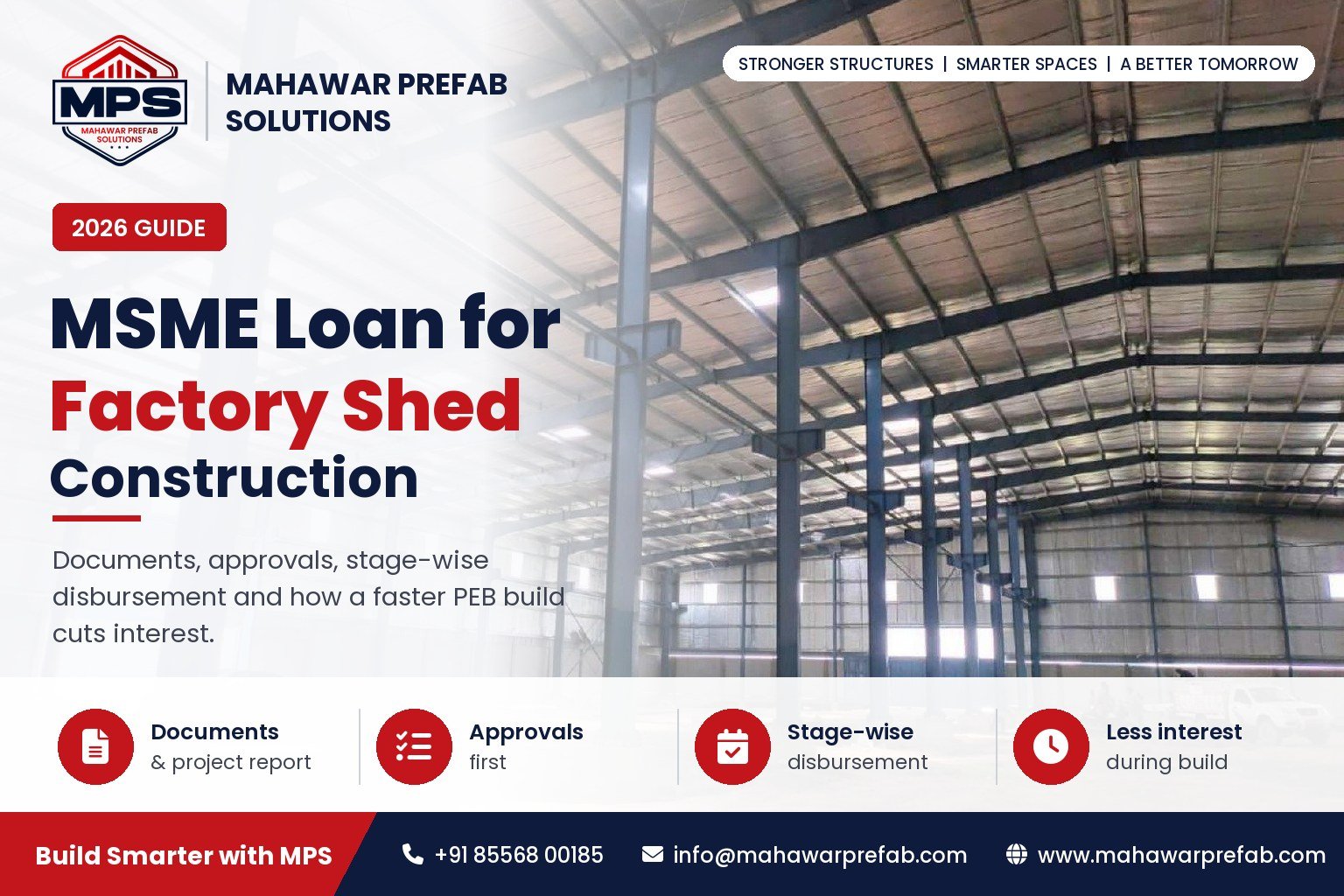
Most MSMEs fund a new factory shed with a normal bank term loan, sometimes backed by a CGTMSE guarantee so that less collateral is needed. The bank decides what it will finance (land, building, machinery or all three), how much you must bring yourself, and releases the money in stages as the building goes up. A pre-engineered building (PEB) does not change these rules, but a shorter build can mean less interest paid before your factory earns anything.
This guide is part of our Budget 2026 MSME schemes series.
What a factory shed loan usually covers
There is no separate government “shed loan”. A factory building is normally financed as part of a term loan (a loan repaid in instalments over several years) for setting up or expanding a unit. The bank looks at the whole project, not only the shed.
- Land: some banks finance it, many do not, or only partly. Do not assume it is covered.
- Building / shed: commonly part of the project cost the bank looks at, along with civil works such as foundations, flooring and boundary wall.
- Machinery: usually the core of a manufacturing loan.
No scheme we found says in writing that it funds shed construction specifically. The bank decides what it finances, based on your project report and repayment capacity.
Promoter contribution (margin)
The bank will not fund 100% of the project. The part you bring from your own money is called the promoter contribution or margin. It shows the bank you have your own stake in the project.
The margin varies by bank, loan size and your track record, so there is no single figure. As one published example, SIDBI’s General Purpose Term Loan sheet mentions promoter contribution of 33% for new projects and up to 25% for well-performing existing units, with debt-equity not above 3:1. That sheet is undated, so confirm current terms with SIDBI. Your own bank may ask for more or less.
Documents the bank will ask for
A typical term loan file for a new building includes:
- Udyam registration certificate and GST registration.
- Project report / DPR (detailed project report): project cost, means of finance, projected sales and profits, and DSCR (debt service coverage ratio, which shows whether your cash flow can cover the instalments).
- Land papers: sale deed or lease deed, mutation/jamabandi, and change of land use (CLU) where needed.
- Approved building plan and building permit.
- Engineer’s estimate for civil works (foundations, flooring, drains, boundary wall).
- PEB quotation with general arrangement drawings and a BOQ (bill of quantities: an itemised list of steel, sheeting and accessories with rates).
- Machinery quotations from suppliers.
- KYC, ITRs and bank statements.
For example, Dhanlaxmi Bank’s published MSME loan checklist asks for the Udyam certificate, GST registration, “copy of approved plan and building permit”, estimates for civil construction, machinery quotations, and projections showing DSCR.
A lump-sum figure on a letterhead is weak; drawings plus a clear BOQ let the bank’s valuer check the cost.
Udyam: the shed does not push you into a bigger category
Your MSME category depends on investment in plant and machinery and on turnover. Limits in force from 1 April 2025 (S.O. 1364(E)):
| Category | Investment up to | Turnover up to |
|---|---|---|
| Micro | Rs 2.5 crore | Rs 10 crore |
| Small | Rs 25 crore | Rs 100 crore |
| Medium | Rs 125 crore | Rs 500 crore |
Land and building are excluded from the investment figure under the Udyam notification. So spending on a new factory shed does not by itself move you from micro to small, which matters for schemes such as CGTMSE that cover only micro and small units.
Stage-wise disbursement: money follows progress
Banks usually release a building loan in parts as work is done, often after a site visit or an engineer’s certificate. A typical pattern:
- Your margin goes in first or in proportion.
- Release for foundations and civil works once they are complete.
- Release for the steel structure and roofing against supplier invoices and site progress.
- Final release on completion, sometimes linked to the completion or occupation certificate.
The order and percentages are set by your bank. Ask how many stages it will use.
Practical tip: ask your PEB supplier for a payment schedule that matches the bank’s release stages. If the supplier wants a large advance before the bank releases anything, the gap comes from your pocket.
Interest during construction: a worked example
While the shed is built, you pay interest on what has been drawn but the factory is not yet earning. This is interest during construction (IDC). A shorter build reduces it.
Illustration only. Assumptions: building loan of Rs 1 crore; interest 9.5% per year; loan drawn in equal monthly instalments at the start of each month; simple interest; build period of 4 months for a PEB shed and 10 months for a conventional build. These periods are assumptions for the arithmetic, not a promised timeline. Your actual rate, draw pattern and build time will differ.
| Item | Shorter PEB build (4 months) | Longer conventional build (10 months) |
|---|---|---|
| Loan amount | Rs 1,00,00,000 | Rs 1,00,00,000 |
| Monthly draw | Rs 25,00,000 | Rs 10,00,000 |
| Interest paid during construction | about Rs 1,97,917 | about Rs 4,35,417 |
| Difference | about Rs 2,37,500 less interest with the shorter build | |
Also, once the full Rs 1 crore is drawn, every extra month of delay at 9.5% costs about Rs 79,167 in interest. And earlier production means repayments come from sales sooner.
Compare full cost and time in our PEB vs RCC guide, and see indicative rates in the warehouse PEB cost guide.
Guarantee options: borrowing with less collateral
CGTMSE (micro and small units)
Under CGTMSE’s CGS-I scheme, banks can give micro and small enterprises term loans and working capital without collateral or third-party guarantee, with the trust guaranteeing a share of the loan. The ceiling was raised from Rs 5 crore to Rs 10 crore for guarantees approved on or after 1 April 2025 (CGTMSE Circular 250). Cover is usually 75% of the loan (85% for some groups, including ZED-certified units, and 90% for women-led units), with an annual guarantee fee of 0.37% to 1.20% depending on loan size, plus any risk premium your bank adds.
Whether the bank uses CGTMSE for your building loan is the bank’s call. Full details are in our CGTMSE loan for factory shed guide.
MCGS-MSME (machinery-led projects)
The Mutual Credit Guarantee Scheme gives lenders a 60% guarantee through NCGTC for loans up to Rs 100 crore to Udyam-registered MSMEs buying equipment or machinery (PIB, Jan 2025). Since the change announced on 21 March 2026, at least 60% of the project cost must be machinery/equipment (PIB, Mar 2026). Ask your bank how the shed portion would be treated.
What does not fit
- ECLGS 5.0 (approved May 2026) is for extra working capital to existing borrowers, not for building (PIB).
- PMEGP guidelines allow the cost of a ready-built or rented workshed, and land cost is not included. They do not say a newly built shed is covered, so do not plan a new PEB around PMEGP without checking with your DIC (District Industries Centre).
- The SME Growth Fund (Rs 10,000 crore, approved 6 October 2026) is equity through an AIF, a privately pooled investment fund registered with SEBI, not a loan. Details on how to apply are awaited. See our SME Growth Fund explainer.
Approvals come before disbursement
Banks generally want approvals in hand before releasing building money, because an unapproved structure is weak security. In Punjab:
- Right to Business route: under the Punjab Right to Business Act 2020 (amended 2025), an eligible enterprise can get a Certificate of In-Principle Approval (CIPA) within 5 working days in approved industrial parks, or 15 working days for new units on planned land outside parks.
- Fire safety certificate: under the Punjab Fire and Emergency Service Act 2024, a provisional certificate is needed before building plan approval and a final one before the completion certificate.
- Factory plan approval and stability certificate: under the Punjab Factory Rules 1952, factory plans are approved by the Labour Department, and manufacturing cannot start in a new building until a stability certificate (Form 1-F) from a competent person, who must not be employed by the owner or builder, is accepted (Punjab Labour Dept).
Haryana passed its own Right to Business law for Udyam-registered MSME manufacturing units in September 2026, with a 15-working-day in-principle approval (as reported by ThePrint). In Punjab, the current incentive policy for new units is the Industrial & Business Development Policy 2026 (notified 8 March 2026); MSMEs need at least ZED Bronze certification to claim its post-production incentives. State incentives that may cut your project cost are covered in our state subsidy for factory shed 2026 post.
What this means if you are planning a factory shed or warehouse
- Budget: fix shed size and specification first, then loan plus margin. Changing design after sanction means fresh estimates.
- Timeline: approvals and bank appraisal usually go more smoothly when drawings are ready early.
- Documents: ask your PEB supplier for drawings, a BOQ and a stage-wise payment schedule that you can put straight into the bank file.
- Steel standard: the quotation should name steel to IS 2062 (Part 1):2025 and seismic design to IS 1893 (Part 1):2016 (the 2025 revision was withdrawn, as reported).
- Tax: GST on PEB supply is generally 18% (confirm with your CA), and GST paid on building your own shed is generally not claimable as input tax credit, so include it in project cost.
- Expansion later: if you may extend the shed, tell the designer now so end frames and foundations allow it.
Mahawar Prefab Solutions is itself a ZED Bronze certified MSME. ZED is worth a look for your own unit: it can raise CGTMSE cover to 85% and is needed for Punjab’s 2026 incentives. See our 20,000 sq ft PEB warehouse for Ashirvad by Aliaxis in Tapa Mandi or learn more about pre-engineered buildings.
Checklist before you apply
- Udyam and GST registration in place.
- Land title clear; CLU done if needed.
- Shed size, height and crane needs decided.
- PEB quotation with drawings and BOQ; civil engineer’s estimate.
- Building plan, fire certificate and factory plan approvals applied for (or Right to Business route used).
- Project report with DSCR prepared, ideally with your CA.
- Margin money arranged and its source documented.
- Ask the bank: Is CGTMSE cover possible? How many release stages? Moratorium period?
- Check state incentives before finalising the project cost.
Planning a shed and building your bank file? Share your plot size and use, and we can prepare a PEB quotation with drawings and a BOQ for your bank. Call toll-free 1800 309 1940, WhatsApp +91 85568 00185, or email info@mahawarprefab.com. We serve Punjab, Haryana and other locations.
Scheme details change; confirm with your bank, DIC or CA before applying. This is general information, not financial advice.
Frequently asked questions
Can I get an MSME loan for factory shed construction?
Yes, a factory shed is usually financed as part of a term loan for setting up or expanding a unit. The bank decides what it finances (land, building, machinery) and how much margin you must bring, based on your project report.
Does CGTMSE cover a loan for a PEB shed?
CGTMSE covers collateral-free term loans and working capital to micro and small enterprises up to Rs 10 crore. It does not name sheds specifically, so whether your building loan is covered is decided by your bank.
How much of my own money do I need?
It varies by bank and project. SIDBI’s General Purpose Term Loan sheet mentions 33% promoter contribution for new projects, but your bank may ask for a different amount. Ask before finalising the shed size.
Will building a factory shed change my MSME category?
No. Land and building are excluded from the investment figure used for Udyam classification. Only plant and machinery investment and turnover count.
Why does a shorter construction period matter for my loan?
You pay interest on the amount drawn while the shed is being built, before the factory earns. In our illustration, a Rs 1 crore loan at 9.5% costs about Rs 1.98 lakh in interest over a 4-month build and about Rs 4.35 lakh over a 10-month build.
What does the bank need from my PEB supplier?
Usually a quotation with drawings and a bill of quantities, so the bank’s valuer can check the cost. A stage-wise payment schedule that matches the bank’s release stages also helps.