Updated: 7 October 2026
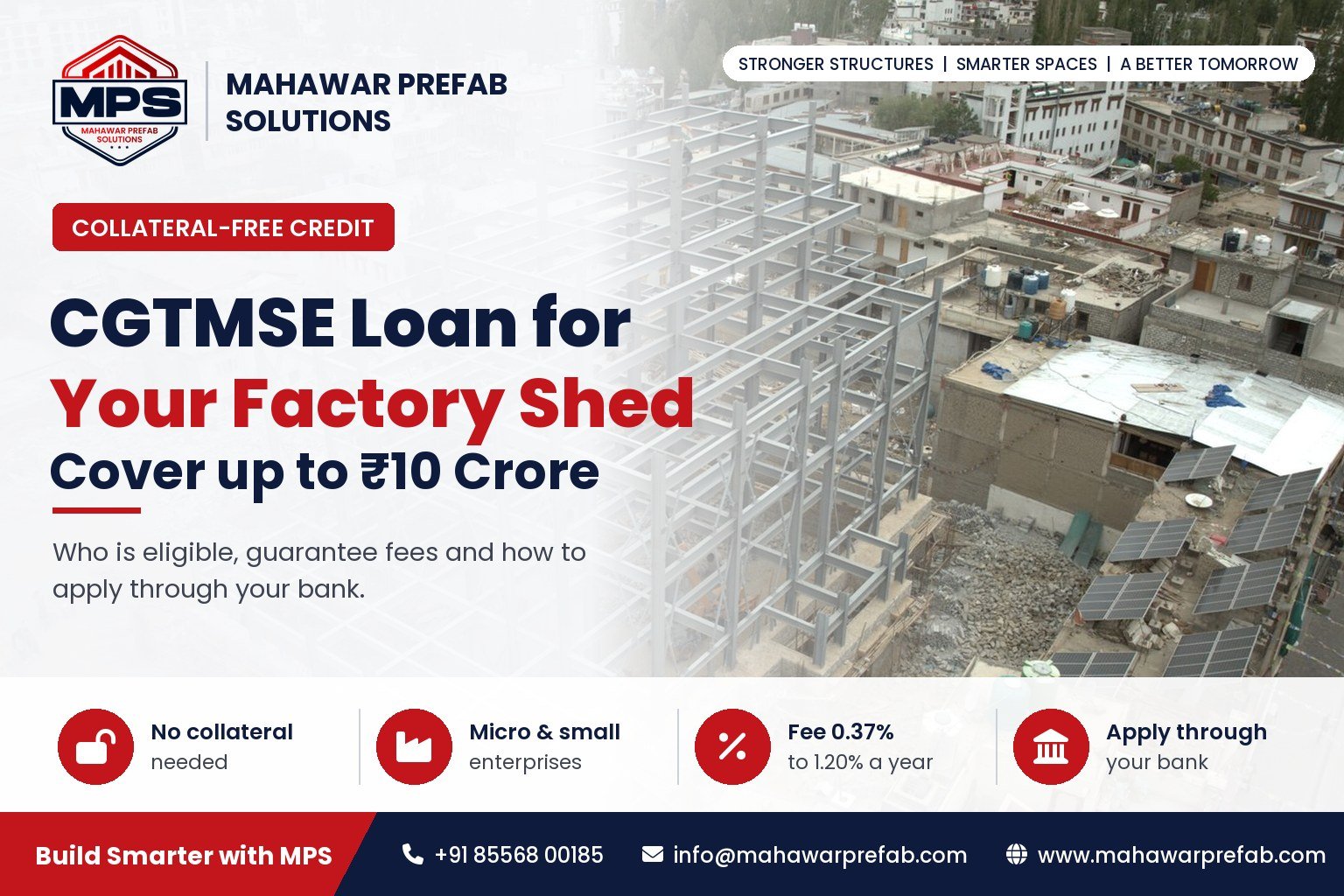
Short answer: CGTMSE does not lend money. It gives your bank a guarantee, so the bank can sanction a loan to a micro or small enterprise without asking for collateral or a third-party guarantee. Since 1 April 2025 the limit is Rs 10 crore per borrower. The guarantee covers the loan (the credit facility), not a particular type of asset, so whether that loan pays for a factory shed is the bank’s decision.
What is CGTMSE?
CGTMSE stands for the Credit Guarantee Fund Trust for Micro and Small Enterprises. It was set up by the Ministry of MSME and SIDBI and has been issuing guarantees since August 2000. As shown on the CGTMSE website (October 2026), it has approved about 1.41 crore guarantees worth Rs 13.67 lakh crore.
If a covered loan goes bad, CGTMSE pays the bank a large share of the loss. That lowers the bank’s risk, so it can lend against the business itself.
The scheme for banks is called CGS-I (Credit Guarantee Scheme I), which this post covers.
Who is eligible?
- Micro and small enterprises only. Medium enterprises are not covered under CGS-I.
- Through a member lending institution. You do not apply to CGTMSE directly. Your bank (or NBFC) must be registered with CGTMSE and applies for the guarantee on your loan.
- Collateral-free loans. The loan must be given without collateral security and/or third-party guarantee.
- Term loan, working capital, or both. Fund-based and non-fund-based working capital are covered.
- Loans above Rs 50 lakh must be rated “investment grade” in the bank’s own internal rating.
Micro and small are defined by your Udyam registration. From 1 April 2025, a micro unit has investment up to Rs 2.5 crore and turnover up to Rs 10 crore; a small unit has investment up to Rs 25 crore and turnover up to Rs 100 crore. Investment here means plant, machinery and equipment. Land and building are not counted, so a new shed does not push you out of the micro or small category.
The Rs 10 crore limit (2026 rules)
The ceiling was raised from Rs 5 crore to Rs 10 crore for guarantees approved on or after 1 April 2025, by CGTMSE Circular No. 250/2024-25. This also applies to working-capital increases on accounts already covered. The Budget 2026-27 backgrounder on PIB confirms the Rs 10 crore figure.
Ask your bank how much of the Rs 10 crore you already use through existing covered loans, and plan your shed loan, machinery loan and working capital together.
How much of the loan is guaranteed?
CGTMSE does not cover 100% of a default. The share it pays depends on who you are and where you are. For guarantees approved from 1 April 2025, the CGS-I scheme document sets these levels:
| Borrower category | Guarantee cover |
|---|---|
| Micro enterprise, loan up to Rs 5 lakh | 85% |
| Women-led or Agniveer-promoted MSE | 90% |
| SC/ST, persons with disability, transgender-led, Aspirational District, ZED-certified MSE | 85% |
| North-East Region, UT of J&K, UT of Ladakh | 80% |
| All others | 75% |
An extra 5% cover applies in districts that RBI has identified as credit-deficient (from 15 December 2023).
Note the ZED-certified row. ZED (Zero Defect Zero Effect) is a Ministry of MSME quality certification. We hold ZED Bronze ourselves, and it helps in more than one scheme.
CGTMSE fee: annual guarantee fee slabs
The bank pays CGTMSE an annual guarantee fee (AGF) for each year the loan is covered. In practice, banks usually recover it from the borrower, so ask your bank how they will charge it. The standard CGS-I rates are:
| Guaranteed amount | Standard annual fee (% per year) |
|---|---|
| Up to Rs 10 lakh | 0.37% |
| Above Rs 10 lakh to Rs 50 lakh | 0.55% |
| Above Rs 50 lakh to Rs 1 crore | 0.60% |
| Above Rs 1 crore to Rs 2 crore | 0.85% |
| Above Rs 2 crore to Rs 5 crore | 1.00% |
| Above Rs 5 crore to Rs 8 crore | 1.10% |
| Above Rs 8 crore to Rs 10 crore | 1.20% |
Source: CGS-I scheme document (updated 1 April 2025) and CGTMSE Circular 262/2026-27. A risk premium linked to your bank’s track record may be added on top, so the final rate can differ from bank to bank.
Fee concessions
CGS-I gives a 10% concession on the fee for each category group, and these can add up. The groups are:
- Social: for example women, SC/ST, persons with disability, transgender-led units.
- Geographic: North-East Region, J&K and Ladakh (for these three, only on loans up to Rs 50 lakh), and Aspirational Districts.
- Credit-deficient district or ZED-certified.
The scheme document’s own examples show combined concessions of 20% and 30%. A 10% concession means 10% off the fee, not 10 percentage points. So a 0.85% fee becomes about 0.765%.
What does “collateral-free” actually mean?
It means no extra security outside the business, such as your house, farmland or a relative’s guarantee. It does not mean “no security at all”: the bank still holds a charge on what the loan pays for, such as machinery, stock, receivables and any building it finances.
If a bank asks you for outside collateral, ask clearly whether your loan is being sanctioned under CGTMSE at all, and on what terms. The scheme is meant for loans given without such security.
Can a CGTMSE loan pay for a factory shed?
CGTMSE guarantees a credit facility (a term loan or working capital). We did not find wording in the CGTMSE scheme document, or in other scheme documents we checked, that says in plain words it funds shed or building construction. In practice, the bank decides what it finances as part of the project.
Banks usually look at the whole project: shed, machinery, electrical work and working capital. For example, one bank’s MSME checklist asks term-loan applicants for a copy of the approved plan and building permit, estimates for civil construction and machinery quotations. Our guide to MSME loans for factory shed construction covers the loan side in more detail.
For bigger, machinery-led projects, MCGS-MSME offers a 60% guarantee on loans up to Rs 100 crore, but at least 60% of the project cost must be machinery or equipment. See our Budget 2026 MSME schemes guide.
Punjab tip: the state refunds your CGTMSE fee
Punjab’s Industrial & Business Development Policy 2026 (Punjab Gazette, 8 March 2026) reimburses 100% of the CGTMSE fee for micro and small enterprises, up to Rs 3 lakh per unit per year, for 7 years from the start of commercial production (clause 5.2.10).
Two conditions to note:
- MSMEs need at least ZED Bronze certification at the time the incentive application is approved to get post-production incentives (clause 5.1.6).
- The old 2022 policy (Rs 2 lakh a year for 5 years) is closed to new applications. Only units already registered under it continue on those terms.
Check timelines with your District Industries Centre (DIC) early. Other state incentives are in our state subsidy guide for factory sheds.
New in 2026: CGTMSE cover on TReDS
TReDS is an online platform where MSEs sell their unpaid invoices from large buyers to financiers. The Budget Speech 2026-27 (para 30) promised CGTMSE guarantee support for invoice discounting on TReDS. CGTMSE Circular 262/2026-27 (15 June 2026) offers 75% cover where both buyer and seller are micro or small, effective once RBI approves CGTMSE operating on TReDS. News reports say the cover went live on some platforms in late September 2026; official confirmation is awaited.
This is working-capital help, not shed finance, but faster payment helps you service a building loan.
Step by step: getting a CGTMSE-backed loan
- Get Udyam registration (on the government Udyam portal) and check that you fall under micro or small.
- Prepare a project report with costs and a repayment plan.
- Collect quotations: a detailed PEB quotation and layout drawings for the shed, plus machinery quotations.
- Approach a member bank and ask in writing that the loan be considered under CGTMSE without collateral.
- Bank appraisal of your business and project.
- Sanction and guarantee: the bank applies to CGTMSE for the guarantee; you pay the fee as the bank advises.
- Claim state refunds: in Punjab, ask your DIC how to claim the fee reimbursement under the 2026 policy once commercial production starts.
A worked example
Suppose a small manufacturer in Punjab needs Rs 1.5 crore for a new 10,000 sq ft PEB shed plus machinery. As a rough guide, our PEB cost guide puts the steel building for a basic warehouse at Rs 300 to Rs 400 per sq ft, so the steel shed could be around Rs 30 to 40 lakh. Foundation, flooring, electrical work and GST (generally 18% on a PEB supply; confirm with your CA) are extra, and the rest of the loan goes to machinery and working capital.
- Rs 1.5 crore falls in the “above Rs 1 crore to Rs 2 crore” slab: standard fee 0.85% a year, about Rs 1.28 lakh.
- If the unit is ZED-certified, a 10% concession brings it to about Rs 1.15 lakh (plus any risk premium).
- Cover would be 85% for a ZED-certified unit, against 75% otherwise.
- Under Punjab’s 2026 policy, this fee is within the Rs 3 lakh yearly cap, so it could be fully reimbursed for up to 7 years from commercial production, subject to eligibility (including ZED Bronze).
These are illustrations only; your bank calculates the actual fee.
What this means if you are planning a factory shed or warehouse
- Budget as one project. Keep the shed, machinery and working capital within one plan so the total stays within Rs 10 crore and your bank sees the full picture.
- Get proper documents early. Banks typically ask for an approved plan, construction estimates and quotations. A pre-engineered building quotation normally states the steel weight and what is included, which makes it easier for a bank to check.
- Plan the timeline. Punjab’s fee refund, and many other state incentives, count from commercial production, so delays in building the shed delay them too. Our PEB vs RCC comparison explains the time difference.
- Think about expansion. A PEB shed can be extended later by adding bays. Design the first phase so the next loan can add space without rebuilding.
- Check approvals. Your bank may ask for building plan, fire and factory approvals before it releases the full amount.
Growing small and medium manufacturers who want equity (investment in return for a share of the business) rather than a loan can keep an eye on the new Rs 10,000 crore SME Growth Fund; how to apply has not been announced yet.
For an example of a finished project, see our 20,000 sq ft warehouse for Ashirvad by Aliaxis in Tapa Mandi.
Need a quotation and drawings for your bank file?
We are a ZED Bronze MSME manufacturer of pre-engineered buildings based in Mandi Gobindgarh, Punjab, and we work across Punjab and nearby states. Share your plot size and use, and we can prepare a detailed quotation and layout that you can put in your loan file. Call toll-free 1800 309 1940, WhatsApp +91 85568 00185, or email info@mahawarprefab.com.
Scheme details change; confirm with your bank, DIC or CA before applying. This is general information, not financial advice.
Frequently asked questions
What is the CGTMSE limit in 2026?
The limit is Rs 10 crore per borrower under CGS-I for guarantees approved on or after 1 April 2025. It was Rs 5 crore before that.
Can I get a CGTMSE loan for a factory shed?
CGTMSE guarantees the loan, not a particular asset. The bank decides what it finances, and a bank may include the shed as part of a project loan for a micro or small enterprise.
What is the CGTMSE fee?
The standard annual guarantee fee ranges from 0.37% for loans up to Rs 10 lakh to 1.20% for loans above Rs 8 crore up to Rs 10 crore, plus any risk premium. Concessions of 10% per category group can reduce it.
Are medium enterprises eligible for CGTMSE?
No. CGS-I covers only micro and small enterprises. Medium enterprises can look at other schemes such as MCGS-MSME for machinery-led projects.
Does Punjab refund the CGTMSE fee?
Yes. Punjab’s Industrial & Business Development Policy 2026 reimburses 100% of the CGTMSE fee for micro and small enterprises, up to Rs 3 lakh per unit per year for 7 years from commercial production. ZED Bronze certification is needed for post-production incentives under the policy.
Do I apply to CGTMSE directly?
No. You apply for the loan at a bank or lender that is a CGTMSE member. The lender applies to CGTMSE for the guarantee on your loan.